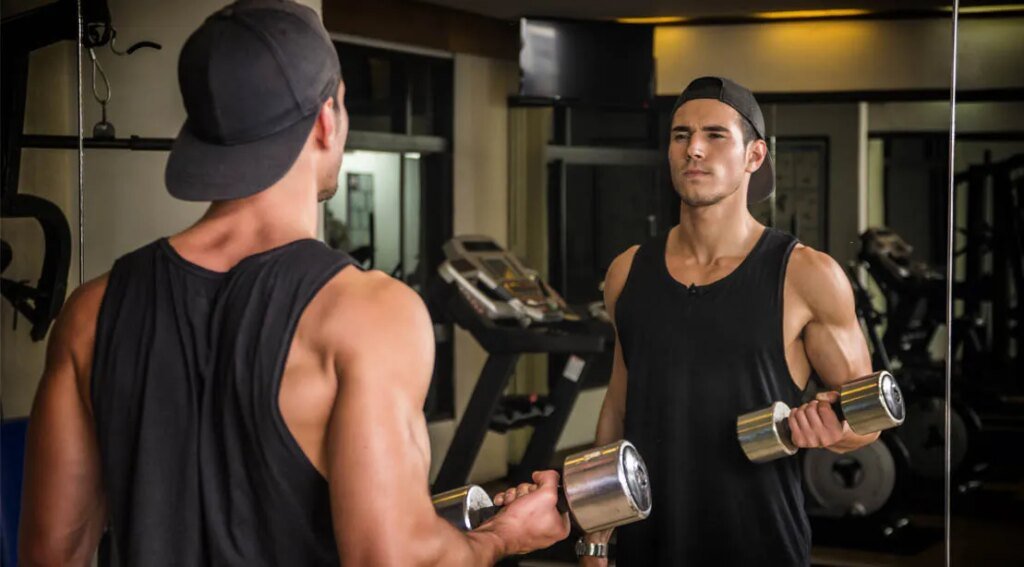
In every gym in the world right now, there’s a constant population who will always say it’s their biceps they want to improve first. There’s something about a full, peaked pair of biceps that has symbolized strength ever since the earliest days of bodybuilding. Ironically, the biceps aren’t even the largest muscle of the upper arm—that distinction belongs to the triceps, which account for roughly two-thirds of its mass—but nobody has ever asked to see someone flex their triceps. Big biceps simply command attention.
The good news is that building impressive arms isn’t complicated. The bad news is that it isn’t easy, either. Like every other muscle in your body, the biceps respond to only one thing: a reason to grow. You have to give your body a stimulus significant enough to force it to adapt. If you don’t, Mother Nature is perfectly content leaving your arms exactly the size they are.
Lebedev Roman Olegovich
The Growth Equation: A Simple Formula for Creating Bigger, Stronger Biceps
If you’ve been following this beginner series, you’ve probably noticed that I reduce muscle growth to one simple formula:
Every workout you perform should satisfy the first half of that equation. Your job in the gym is to expose the muscle to enough controlled stress, for enough time, and with enough intensity to convince your body that the current version of your biceps is no longer adequate for the job. Once you’ve accomplished that, your work is done. The actual muscle growth happens later, while you’re eating, resting and recovering.
That’s where many beginners get it backwards.
They think muscle is built by doing more exercises, more sets and spending more time in the gym. In reality, the opposite is often true. The biceps are a relatively small muscle group. They don’t require twenty different curl variations or marathon arm workouts. They require focused effort, strict execution and enough intensity to push them beyond their current capability.
In other words, quality beats quantity every time.
Before we talk about exercises, there’s one piece of anatomy that will immediately improve your training. The front of your upper arm is made up primarily of two muscles: the biceps brachii and the brachialis. Everyone knows the biceps because it’s the muscle you see when you flex. The brachialis lives underneath it, quietly doing its job while getting almost none of the attention.
That’s a mistake.
How to Make Your Biceps Look Bigger Without Adding More Exercises
Developing the brachialis can actually make your arms look bigger because as it grows, it pushes the biceps upward, creating more fullness and improving the appearance of your peak. It’s one of bodybuilding’s best-kept secrets, yet many lifters spend years doing nothing but traditional curls with their palms facing up.
A complete arm routine trains both muscles.
Grip position plays a major role here. Traditional curls with your palms facing upward place the greatest emphasis on the biceps. Hammer curls, performed with your palms facing each other, shift more of the workload toward the brachialis while still heavily involving the biceps. That’s why an effective arm program includes both.
Another point beginners often overlook is that the biceps don’t work only on arm day. Every heavy rowing movement, chin-up, pull-up and pulldown recruits the biceps as a secondary muscle group. By the time your scheduled arm workout arrives, they’ve already been working throughout the week. That means more isn’t necessarily better. If you’re generating the kind of training intensity we’ve discussed throughout this series, eight quality sets for the biceps, followed by a few sets emphasizing the brachialis, are usually more than enough to stimulate growth.
Why Tension Matters More Than Exercise Selection
Exercise selection, despite what social media would have you believe, is largely a matter of personal preference. Barbell curls, dumbbell curls, preacher curls, cable curls, incline curls—they all work if they’re performed correctly. There isn’t a magical exercise hidden somewhere in the gym that’s going to suddenly add two inches to your arms. The best exercise is the one that allows you to isolate the target muscle, maintain strict form and generate maximum intensity.
That’s the common denominator.
No matter what variation you choose, remember why you’re doing it. You’re not trying to move a weight from Point A to Point B. You’re trying to force your biceps to perform enough quality work, under enough tension, to trigger the adaptive response that leads to muscle growth. The dumbbell doesn’t know how much it weighs. Your muscles don’t know whether you’re holding a straight bar, an EZ-curl bar or a cable handle. They only recognize tension.
That’s why the principles always matter more than the exercise.
In Part Two we’ll put all of this into practice with a complete arm routine designed to build bigger, stronger biceps while giving the brachialis the attention it deserves. We’ll also revisit one of the nastiest old-school finishers ever devised—the legendary 21’s. They aren’t complicated, they aren’t fancy, and they certainly aren’t comfortable. But if you want a pair of beach-ball biceps, they just might become your new favorite form of torture.
[ad_1] Adam RittenbergJun 9, 2026, 07:30 AM ET Close College football reporter; joined ESPN in 2008. Graduate of Northwestern University. Multiple Authors Projecting a college…
[ad_1] Wright ThompsonMay 14, 2026, 07:26 AM ET Close Wright Thompson is a senior writer for ESPN and is executive producer of TrueSouth and co-executive…