
The Bayesian Curl May Be One of the Best Biceps Exercises for Building Bigger Arms

[ad_1]
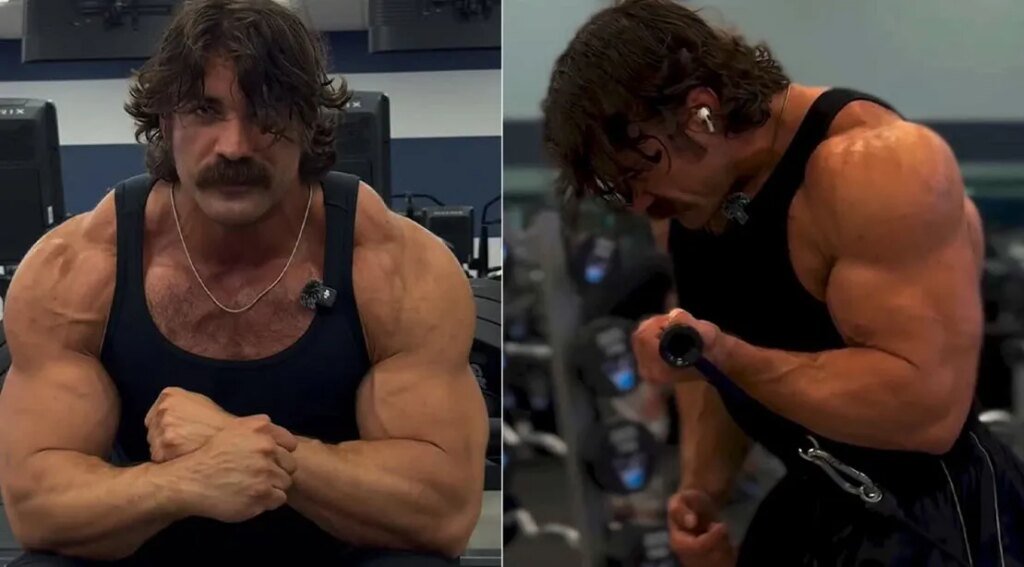
Traditional dumbbell bicep curls are a tried and tested method for building the biceps, but despite the free weight’s ability to activate the target muscle, there are plenty of reasons to consider the cables when changing up, or boosting your sleeve busting routine. In fact, Moritz Willen, a Swiss born bodybuilder with a growing fanbase on Instagram has recently shared why Bayesian curls are now a staple of his arm day.
“Unlock your bicep potential with this freaking cooker!” enthused Willen in a recent Instagram post. The big man, who is nearing 100,000 IG followers, including UFC legend Mark Coleman, was born in Bern, Switzerland and now lives in Santa Barbara, where he designs buildings by day and constructs his body at every available chance.
What is the Bayesian Bicep Curl?
The mechanism of a Bayesian curl is similar to a traditional curl, because the idea is to pull the weight upwards with a supinated (underhanded) grip, moving the load towards your chest and activating the biceps in the process. Where it differs however, is that instead of carrying the weight by gripping a dumbbell, you’ll be working with cables, providing a host of benefits to help blast your biceps.
“Standing cable Bayesian curls keep tension locked on the bicep from start to finish,” explained Willen. “The cable resistance means you’re working throughout the entire range of motion, not just at the peak. You don’t need heavy weight, just enough to light your arms on fire.”
Do Bayesian Curls Build Bigger Arms Than Dumbbell Curls?
While both dumbbell curl and bayesian curl variations primarily target the short and long heads of the Biceps brachii, working the shoulders and forearms on a secondary basis, the use of cables mean that the body is not required to stabilize a free weight such as the dumbbell. This means that more of your focus can go into building fuller biceps.
“Focus on dragging that handle up with intention, feeling every inch of the contraction,” explains Willen of the control that the cables can help to provide. “Progressive overload happens naturally when you dial in the form and squeeze harder, leaning into that mind-muscle connection.”
How To Do The Bayesian Curl Variation
- You’ll begin this exercise facing away from the cable station,
- planting your front foot and leaning forward as you make the curl with the opposite arm to the leading leg.
- Squeeze as you contract, then lean back as you lower the weight and get a full stretch of the biceps.
Studies have shown that training the elbow flexors at longer muscle lengths during curls can produce greater increases in muscle strength and muscle thickness. Cables provide ample opportunity to make such stretches, since the negative portion of the lift follows the track of the cable.
“Once you got the connection, it’s time to chase bigger numbers on the stack,” enthused Willen. “Keep increasing resistance, as your recovery allows, and watch your biceps turn into Swiss mountain peaks.”
To follow Moritz Willen on Instagram, click here.
[ad_2]
Credit to: Source link