Will NFL officiating improve under the referees’ new CBA?



Kevin Seifert
Close
Kevin Seifert
ESPN Staff Writer- Kevin Seifert is a staff writer who covers the Minnesota Vikings and the NFL at ESPN. Kevin has covered the NFL for over 20 years, joining ESPN in 2008. He was previously a beat reporter for the Minneapolis Star Tribune and Washington Times. He is a graduate of the University of Virginia.
Kalyn Kahler
CloseKalyn Kahler
ESPN- Kalyn Kahler is a senior NFL writer at ESPN. Kalyn reports on a range of NFL topics. She reported about the influence of coaching agents on NFL hiring and found out what current and former Cowboys players really think about the tour groups of fans that roam about The Star every day. Before joining ESPN in July of 2024, Kalyn wrote for The Athletic, Defector, Bleacher Report and Sports Illustrated. She began her career at Sports Illustrated as NFL columnist Peter King’s assistant. She is a graduate of Northwestern University, where she was a varsity cheerleader. In her free time, Kalyn takes Spanish classes and teaches Irish dance. You can reach out to Kalyn via email.
Multiple Authors
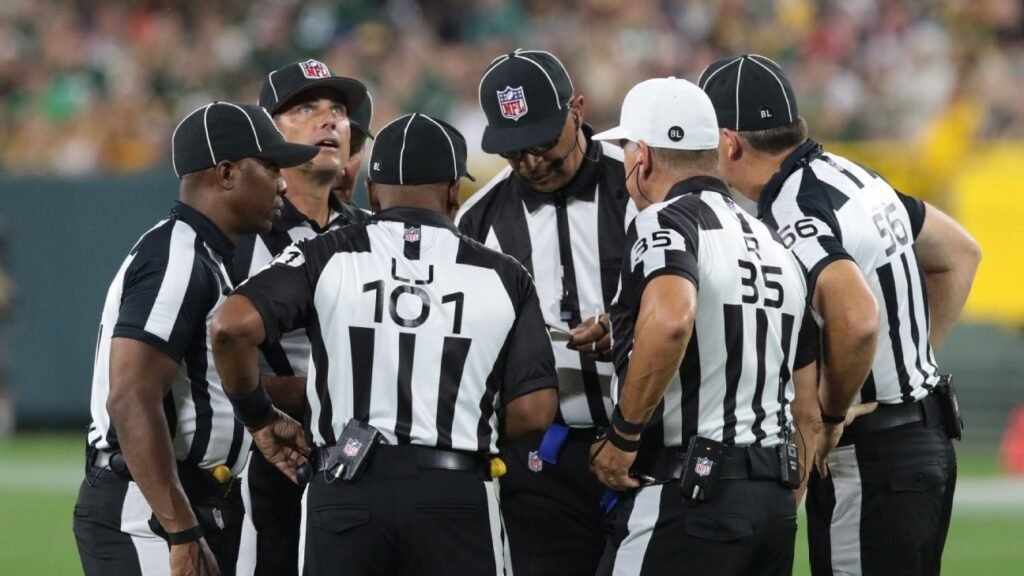
For the first time in its history, the NFL plans to form a practice squad this season of up to 12 game officials. Its members will be assigned to specific crews, travel to stadiums and be available to work games if a starting official is either injured or performing poorly.
As part of its new collective bargaining agreement with the NFL Referees Association, the league said it plans to elevate some practice squad members to work regular-season games for developmental purposes — regardless of circumstance.
Utilizing a practice squad this way would represent a sharp change from previous business and serve as perhaps the most visible change from CBA negotiations that the NFL pledged — publicly and privately — would be dedicated to improving its officiating performance. It has been met with excitement from some league insiders, who have long advocated for what one called an injection of “NFL DNA” into the way officials are managed.
Others are skeptical it will ever be implemented in the way it has been conceived, citing similar failures in the last CBA, signed in 2019. They also noted the risk of inserting untested officials into midseason games and taking already limited reps away from tenured officials.
But after two years of negotiations, and increasingly public threats of a lockout and the use of replacement officials, the sides agreed to terms on the practice squad and several other adjustments.
The NFLRA also accepted elements of the league’s efforts to connect compensation with performance, rather than seniority, to link with the practice squad as the two most tangible elements of entwining NFL DNA with officiating.
To further boost efforts to improve, the sides also codified 14 training dates into an expanded offseason. Lower-performing officials could be made available to the United Football League in future years, and this spring, all crews have been working OTAs and minicamps for the first time.
“I think it is going to create competition amongst the officials from top to bottom,” NFL VP of officiating training and development Ramon George told ESPN.
Said Scott Green, the NFLRA’s executive director: “We’ll do everything we can to improve officiating and we believe there are provisions that will help make that happen.”
While some parts of the final CBA are new, many of the anticipated changes are an expansion or revitalization of existing ideas. Dean Blandino, who served as the NFL’s officiating chief from 2013 to 2017 and is currently a Fox Sports analyst and head of officiating for the UFL, said the distinction is important.
“More work and extra help is not a bad thing,” Blandino said. “It really isn’t. Ultimately, however you package it, it’s very similar concepts that were in place before that they could have done. And that’s where I think some of it is just window dressing.”
ESPN spent the past month digging into the details of the agreement, which lawyers from each side were still finalizing in writing as of mid-June, to answer a simple question: How much can the NFL reasonably expect to improve officiating through the initiatives in the CBA? And how much, if any, is it a façade to satisfy internal and external concerns about officiating performance?
Swing officials
Under the previous CBA, the NFL annually hired 119 officials to distribute equally among its 17 crews. The league usually added two additional “swing” officials to the roster who were typically veterans and available to float between crews as injury substitutes. The new CBA allows the league to hire 10 additional swing officials, bringing the total to 12, to form the new practice squad.
Four of those new 10 will be college officials who would participate in the NFL preseason, work their college seasons, and then be available to work in NFL games — or at least join crews — once the college season is over.
In an interview, George, the VP of officiating training and development, referred to the excess officials as a “bench” that is intended to supplement and push the preexisting crew.
Given the late timing of the agreement, a league source said it is unlikely that it will hire all 12 this year. But those who are hired will be assigned to specific crews, rather than float among them. George said he will make the assignments with an eye toward being better prepared for “future needs,” where they could be possible replacements for officials who are near retirement or had lower performance ratings the previous year.
The agreement calls for those swing officials to be paid for eight games of work. If they work more, their pay will increase accordingly.
“They can swing in and work for individuals who are struggling,” George said. “They are going to be embedded in a crew, learn how to become professionals and take care of their bodies. They will be able to learn the terminology, pace, speed, travel, as well as working those like NFL games.”
Asked if he will assign the practice squad officials to work even if no member of the crew is underperforming, George said: “Oh, absolutely. Yeah.”
A source familiar with the negotiations said that the NFL realized it needed to guarantee eight games paid to the six bench officials it plans to hire in order to convince them to leave their jobs in college football, where they work 10 to 12 games per season. Tenured officials will still be paid for a 17-game season, even if they are rotated off a game for a bench official to take reps.
“The bench is designed primarily for development and to provide depth in the event of injury or performance-related issues with tenured game officials,” an NFL spokesman said. “The number of game assignments was structured to ensure bench officials receive meaningful regular-season experience and evaluation opportunities, including film review that supports their ongoing training and development. It was not about convincing an official to leave another job. Our focus is on having the best on the field.”
Regarding college officials, the NFL spokesman said, “We are confident in their ability to adapt to the NFL environment. These officials possess strong position-specific rules knowledge, have had NFL preseason assignments, and have access to league training and rules resources throughout the season. As part of their development, they will be assigned regular-season games and evaluated using the same developmental approach applied to all game officials.”
If implemented as George described, sources in and around the league’s officiating ecosystem described the impact as a looming culture shock. One noted the “risky” nature of disrupting crew chemistry midseason and using practice squad officials who have been away from the field for weeks and perhaps months.
Another wondered about the effect of officials “looking over their shoulders” to a much greater extent than they previously had. A league source countered that the presence of potential replacements is a work condition that all NFL players and coaches face, one that is considered a reliable motivator for enhanced performance.
Many sources questioned whether, from a logistical perspective, the four college officials who rejoin their crews at the end of the season would ever see the field in a regular-season game. And even if they work only preseason games, their reps will cut into the preparation routines of the officials who will be on the field during regular-season games. Game reps are of maximum value to officials because, unlike teams, they do not have midweek practices.
“All of this sounds good on paper,” Blandino, the former NFL officiating chief, said. “But when push comes to shove, you’re telling me that this crew’s worked together for six weeks, now you’re going to bring in one or two officials who haven’t worked for a month on the field? That’s a challenge.
“We get the idea. But [players] are practicing every day. If I’m a coach, I’m asking, ‘What are the guys on the bench doing when they’re not working [games]? I know what our backup players are doing. But what are those officials doing that I’m going to feel comfortable with them in a game?'”
Training, evaluating and developing officials
The question of how the league should train and develop its officials is central to this CBA, because the league office negotiated to shorten the offseason for officials and use that time for additional training and development.
Previously, the offseason, known as the “dark period,” lasted from the end of the regular season to May 15. During that time, the league office could not require officials to work, though they could request the services of officials during that time. The league could request to assign underperforming officials to games in other football leagues, or request the presence of a group of officials to attend competition committee meetings to discuss rule changes.
In this CBA, the NFL negotiated for the dark period to end for all officials two weeks earlier, on May 1. And for underperforming officials — those evaluated into the lowest levels of the NFL’s officiating evaluation system, Tier 3 and Tier 4 — the offseason will be shorter or nonexistent, and they can be required to participate in training.
Green, the NFLRA’s executive director, said that in this CBA, the union pushed for the fourth tier to the league’s evaluation system because they felt the previous three-tier system was too vague. He noted that in Tier 3, there were officials who were playoff alternates and officials who were terminated for poor performance. Green added that they also negotiated a schedule for the league to notify officials of their performance evaluations three separate times as the season progresses, so that officials have more clarity on how they stack up. Previously, there were two evaluations. The league will be able to contact Tier 4 officials to set up meetings any time after the regular season.
“We think the fourth tier will more accurately identify those that will benefit from additional help, in an effort to get better,” Green said.
George said the shortened offseason is “really centered around individuals who underperformed during the season, and were not assigned to a playoff assignment,” and those officials will begin to work with their supervisors immediately after the regular season to review each of their calls and identify mistakes in mechanics and positioning. After the review, if necessary, George said he will assign officials to work in the UFL.
Several officiating insiders pointed to this part of the CBA as the most optics-driven aspect — the shortened offseason is a talking point to make the league appear like it is taking action to fix officiating.
“The dark period is kind of a misnomer because all it meant was if the league wants access to the officials, they just have to negotiate with the union for fees and time,” Blandino said. “It’s not like, “Oh, we can’t talk to them. We can’t touch them in any way.”
“That’s some of the stuff they put out publicly. Well, we can’t do anything with them until May 15. Well, that’s not entirely true. We would just have to pay beyond their normal duties and responsibilities to get access to those officials.”
A source close to the NFLRA said the union wasn’t happy that the league’s public negotiating stance centered on improving the quality of officiating by having more access to officials, because it implied that officials were against the idea of getting better.
Skepticism about how the changes will work out
Officiating insiders say their skepticism surrounding the expanded offseason and increased training opportunities is heightened by the league’s recent history of inaction. The 2019 CBA included a provision that NFLRA and the NFL must work together to create a training and evaluation program that should be implemented for the 2020 season, but Green says that program never materialized in the seven-year life of that deal.
“We could have started the program several years ago,” Green told ESPN. “We sent them drafts, and we began discussions, but the problem became that they just didn’t have the people that could work on that while they were working on their usual grading. I give Ramon [George] credit that he is fully intending to move forward on that. [Former VP of officiating training and development] Walt Anderson did not show the same interest.”
A league source said the NFL disagrees with Green’s assertion regarding the program outlined in the 2019 CBA.
“Ramon has been working with the NFLRA on a new training and development program and has made good progress,” the source said. “We are committed to training and developing our officials in a way that continues to improve on-field performance.”
Green says he is already in discussions with George about the specific structure for the jointly designed training and development program, one that will address questions such as: What will the league office do in April with the Tier 3 officials who didn’t work a playoff game? Does the league office have sufficient staff to support the additional time with officials?
George said the league office will add eight more coach coordinators to the staff over the next two years to make sure the league can support the training for each of the seven position groups, which would double their current number of eight coach coordinators.
When told the league plans to hire eight more coach coordinators to staff up the officiating department, one officiating insider reacted in shock and wondered what they would be doing.
Two more officiating insiders were skeptical of what the league will accomplish with more time with officials because they think the root of the league’s officiating woes is the inconsistent messaging that officials receive from the league office. They say the evaluation officials receive from the coach coordinators who do the grading doesn’t always match the feedback from their trainer, so officials often lack clarity on whether they were right or wrong on a call.
“If you’re going to have consistent improvement, you need to get that consistent message and funneling and leadership coming from the top,” a club source said. “That’s where the fracture comes from because we’ve had so many changes from the top.”
Clubs got a reminder of that messaging when they received a copy of an unusual memo from the league office, which the league’s officiating department sent to the officials, that outlined expectations ahead of the newly intensified assignments to OTAs and minicamp practices this spring. Previously, crews worked OTAs if they had a rookie on the crew, but this year, all 17 crews worked OTAs.
“The clubs were committed to working with officiating to improve the on-field product,” the league source said.
The memo emphasized how important the league considered the visits. Among other specific instructions, it directed officials to “attend all team and position meetings including film/video review sessions,” even though that had long been the expectation in previous years for visits to teams during training camp. In underlined and bolded text, it advised officials that they needed to do this “even if it requires a return to the Club’s facility.”
Postseason and playoff assignments
Under the last CBA, officials were eligible to receive a postseason assignment after they had officiated two credited seasons. The league’s officiating department has full discretion to assign postseason games based on regular-season evaluation, and past leaders of the league’s officiating department tended to assign officials with five or more years of experience to the postseason.
But George turned heads in officiating circles in 2024, his first year as the league’s VP of officiating training and development, when he assigned two third-year officials to the Super Bowl.
“That’s a huge departure,” Mike Pereira, who was the NFL’s VP of officiating from 2004 to 2009 and is now a rules analyst for Fox, told reporters ahead of that Super Bowl in February 2025. “I always felt like it took five years to get to the level where you’ll feel comfortable going in front of thousands of people.”
“It’s not collectively bargained to have a certain number of years [of experience],” George said that February. “That’s just a rule that whomever is in the position to select, that is their philosophy. I don’t live by that philosophy. If you are the best, then you should be on the field.”
So in this negotiation, the league pushed to remove the two-year eligibility requirement for a postseason assignment.
“We’re taking the best official who had the best year at their position group, and they’re going to have the opportunity to officiate in the playoffs all the way to the Super Bowl,” George said. “We’re taking that experience cap off and really creating the competition from top to bottom.”
The league and the union also agreed to allow officials with three or fewer credited seasons the ability to earn their way off of probationary status if they rank in Tier 1 for one season or rank in Tier 2 for two seasons. During the three-year probation period, officials earn a lower salary and don’t have the union protection that applies to tenured officials. Probationary officials can be terminated by the NFL for poor performance without the need to show cause.
The league also has the ability to extend the probationary period for an official who has ranked in Tier 4 for two seasons until June 1 after the official’s third season, so that the official can participate in training during that extension.
Should previously ineligible officials receive a Super Bowl assignment, they’ll be eligible for additional pay that the NFL classifies as a reward for good performance. In 2026, Super Bowl officials will receive a bonus of $17,720 and $16,560 if they are named an alternate. That total will increase by roughly $1,000 per year over the time span of the CBA.
Bonuses for postseason assignments in earlier rounds of the playoffs range from $11,290 to $13,630. Blandino referred to the change in playoff eligibility and the presence of a larger bench as “a good selling point” as NFL DNA when presented to “coaches and people that are around that all the time.” Blandino, however, said officials have always been in competition for assignments, promotions and, ultimately, continued employment even if it was less visible.
It’s debatable whether CBA negotiations alone can deliver the desired results. But if nothing else, the effort from both the league and the union got everyone on the record: Performance needs to improve. On that, there is no argument.
[ad_2]
Credit to: Source link