USMNT failed at the World Cup because of the players — no coach could save them


Ryan O’Hanlon
Multiple Authors
Three years ago, the United States Soccer Federation released a dossier that I’m still surprised was ever made public. It was titled, “A BREAKDOWN OF THE RIGOROUS PROCESS IN THE SEARCH FOR THE USMNT HEAD COACH.”
The report claimed that the federation had employed things like “advanced data analytics, sophisticated metrics, and cutting-edge hiring methods” to find its next manager of the U.S. men’s national team. Then the federation bragged about the person who oversaw it all:
“When the U.S. Soccer Federation hired Matt Crocker after years of service with English Football Association and Southampton in the English Premier League, he entered the soccer landscape in the United States with a fresh pair of eyes and a rigorous set of criteria for his primary responsibility at the outset of his tenure: identifying the best coach to lead the U.S. men’s national team.”
The cutting-edge criteria and the expert outsider perspective led the USSF to the man who would lead the USMNT to the promised land: the guy who was already there. After the 2022 World Cup, U.S. Soccer took six months and employed what it said was a “battery of practical and psychological testing” to figure out that it just wanted to keep Gregg Berhalter as the coach. Berhalter was signed to a new three-year contract, and 12 months later, when the U.S. was eliminated from the group stage of the Copa America, the federation fired him.
Rather than going through another data-driven dog and pony show to replace Berhalter — what if the “sophisticated metrics” led back to him again? — U.S. Soccer decided to keep it simple and lean on the two things America does better than anyone else: creating celebrities and producing billionaires.
The federation decided it wanted a famous coach with an obvious track record, so it got an uber-rich hedge fund manager, Citadel’s Ken Griffin, to help foot the bill to hire Mauricio Pochettino at a $6-million-a-year salary.
Pochettino is one of the most successful club coaches of the modern era. His teams all play a clear and recognizable style, pressing high up the field and taking risks. They are so-called “protagonists” in their matches: imposing their style and bending the shape of the game to their intensity.
The USMNT had never been protagonists before — until this summer. Crocker left the federation for Saudi Arabia, but Pochettino got the team pushing high, pressing hard and scoring lots of goals. He transformed the way the U.S. men’s national team plays.
And it didn’t matter at all.
On Monday, the U.S. was knocked out of the World Cup in the round of 16, the same stage at which the Americans had exited their previous three World Cups. Use artificial intelligence, hire McKinsey, persuade a billionaire to become American soccer’s modern Medici, put an ad on Craigslist: the result is always going to be the same. The head coach is never going to save the national team.
Why Pochettino succeeded in coaching the U.S.
Managers — head coaches in any sport, really — have one job: get their collection of players performing at a level higher than their collective ability. The main way to do that is to get your best players all on the field together and have them play in a way that amplifies their strengths and hides their weaknesses.
Sometimes that’s impossible. For instance: if your three best players are all goalkeepers. Other times, it’s easy. For instance: if your best players are a striker who scores goals and an attacking midfielder who creates chances. (Hello, Norway.) Most of the time, though, the level of difficulty sits somewhere in between.
That’s where the USMNT is, and Pochettino solved the problem in a way few coaches are able to. At the international level, you don’t get to pick your players and you rarely get to practice together, so most teams play a simplified version of the sport: a game that focuses on defensive organization and slow possession that maintains that structure in case the ball is turned over.
This is why so many games devolve into what we saw in, say, France’s 1-0 win against Paraguay. One team can negate the opposition by sitting deep and packing bodies in the box, but the more talented team — the way, way, way more talented team — struggles to break through because its players don’t have an innate understanding that comes from playing together every day and are unable or unwilling to take the positional risks that might unsettle a deep defense because of how it might expose them to a counterattack.
The U.S., though, had no issue with this negative approach. It, of course, annihilated Paraguay 4-1 in its opening match of the tournament. And it easily dispatched similar strategies employed by Australia and Bosnia-Herzegovina. That’s because Pochettino figured out how to get the U.S. playing like a club team.
Rather than sitting back, Pochettino’s defense pressed high throughout the tournament.
Only two teams that reached the round of 16 did so with a lower PPDA (passes allowed per defensive action) than the USMNT’s 10.15. Only three made more defensive actions in the attacking half of the field, per stats app Futi. Only five tilted the field more aggressively, as the Americans controlled 61.4% of the final-third possession in their matches. And that’s despite playing a full game against Türkiye without their starters and the final half hour of the match against Bosnia with only 10 players.
But pressing teams, especially at the international level, will often struggle to create chances out of this dominance. They pin their opponents in their defensive third and then have to resort to a barrage of low-quality, long-range shots. (Hello, Türkiye.) But this wasn’t true for the Americans because they were able to take the kinds of positional risks we normally see only from club teams.
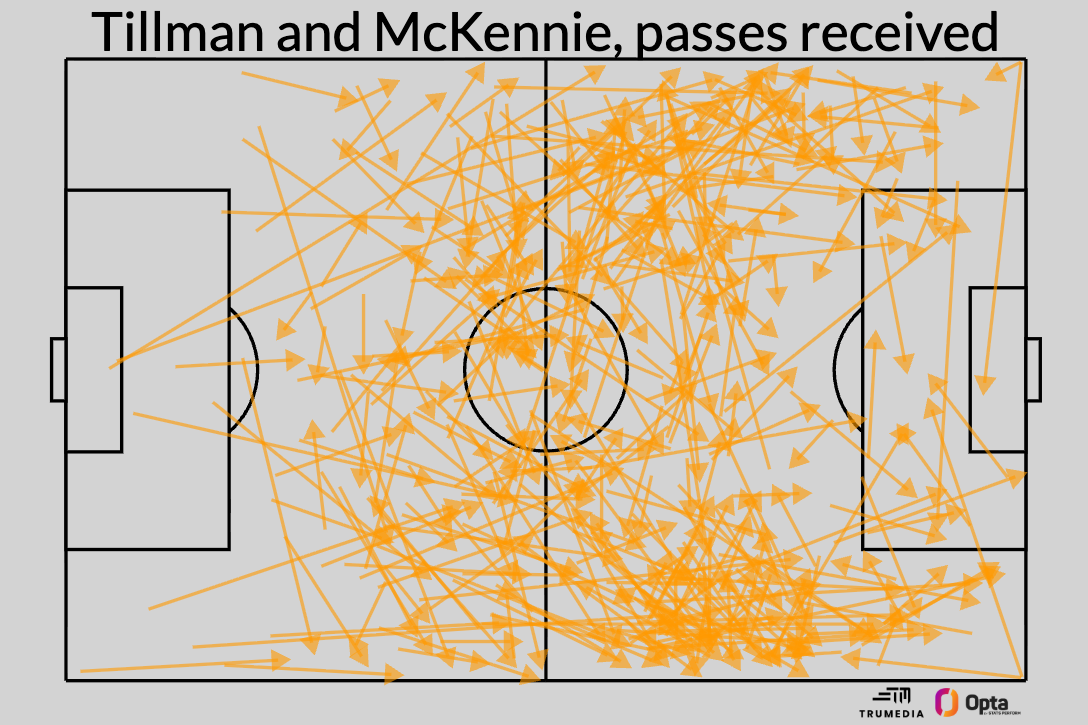
This was most obvious in the performances of Weston McKennie and Malik Tillman. They both played as central midfielders, but take a look at where they received their passes this tournament:
See where they’re not receiving passes? In the middle of the field. They would pull wide and make runs into the box, vacating the spaces where players who play their positions would normally be. This allowed the U.S. to turn the territorial dominance into goals, and it worked in a virtuous way: Whenever the team lost the ball with McKennie or Tillman out of position, the press would simply win the ball back.
The approach also fit the talent of the roster. Modern club teams tend to play with one flexible defender, a player who can pinch in as a third center back in a back three or play as a traditional fullback in a back four over the course of the same game. Alex Freeman occupied this role for the Americans, which meant Sergiño Dest, a fantastic attacking player with defensive limitations, had extra cover behind him.
This then allowed Antonee Robinson, one of the best athletes at his position in the world, to cover the left flank by himself. The inclusion of Freeman made the U.S. structure sometimes resemble the back three in which Chris Richards has flourished with Crystal Palace, and it helped cover up an aging Tim Ream’s defensive deficiencies.
In turn, Ream’s passing ability allowed the likes of Tillman and McKennie to focus their efforts off of the ball. It freed up Tyler Adams, the team’s defensive midfielder, to focus on doing what he does best: cleaning up the space behind his more attacking midfielders. And the shifting of Dest into a quasi-fullback/winger role solved one of the bigger problems within the player pool: the lack of a quality winger to put opposite Christian Pulisic.
It all made so much sense. And it all worked so well — until the U.S. played against a team with better players.
Why Pochettino still failed with the USMNT at the World Cup
Sometimes there are tactical explanations for an outlier result in a soccer match: There are two collections of theoretically equally talented players, but the strengths and weaknesses match up in such a way that one particular strength overwhelms one specific weakness so thoroughly that it defines the match. Or maybe a manager makes some smart, unexpected and unsustainable adjustment. Or, as happens much more often, maybe a manager makes an overly conservative personnel choice and it hampers his team’s ability to perform. (Hello, Netherlands.)
The U.S. loss to Belgium was not any of those things. It was 11 American players almost universally playing terribly.
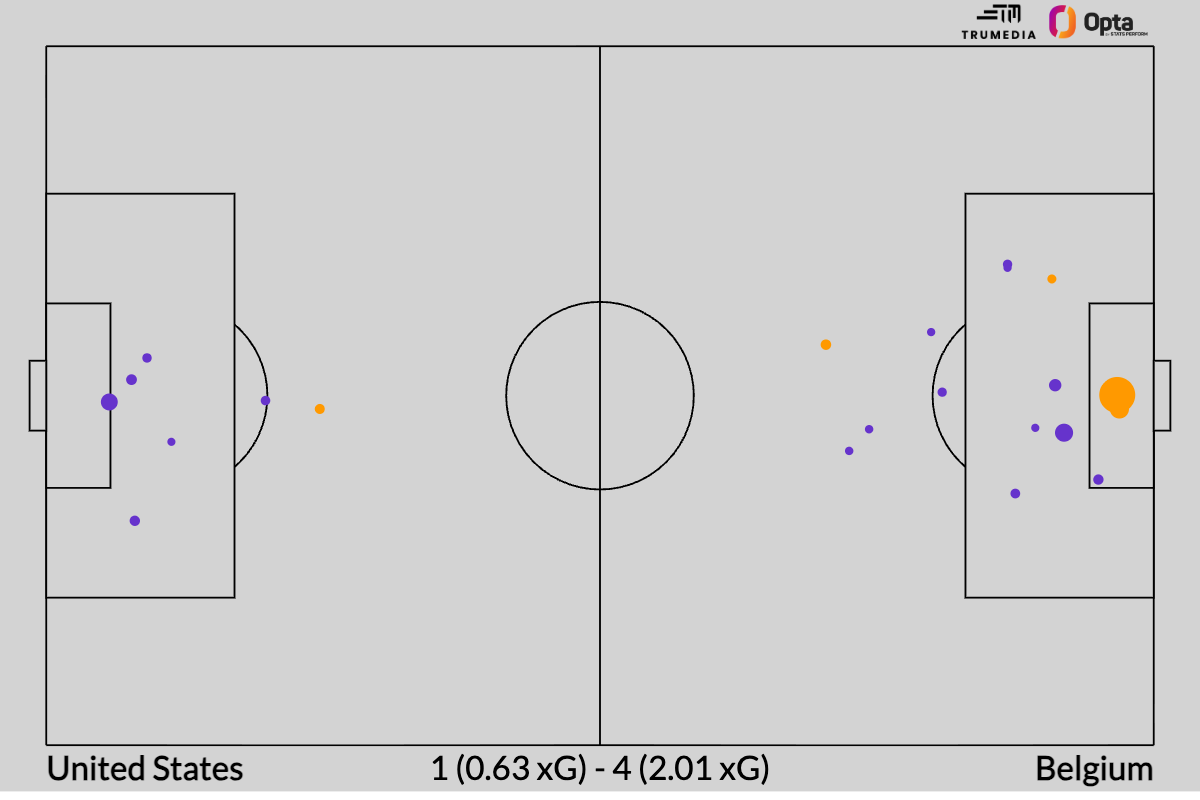
The U.S. controlled possession and territory a little bit, but that was because it fell behind so early and the match state allowed the Americans to get the ball more. What matters is this: The U.S. had 12 touches in the opposition box, compared with the 22 touches it allowed. Despite trailing for most of the game, the U.S. attempted only seven total shots. Its first shot from open play came in the 79th minute, from Sebastian Berhalter.
This wasn’t a game where the ball bounced the wrong way a bunch of times. The U.S. simply got wrecked.
Each circle represents a shot (purple) or goal (orange), and the larger the circle, the higher the xG (expected goals) value of the attempt.
It’s important to note here, too, that the U.S. was favored to win this game. This is a Belgium team that has struggled so far in the World Cup and seemed to be waiting for someone to knock it out.
The squad’s best player, Jérémy Doku, played only the final 30 minutes of the match. Kevin De Bruyne, the best midfielder of his era and Belgium’s best-ever player, didn’t play a single minute. This Belgium team is not the one of World Cups past as it has watched its Golden Generation fade. Yet it easily bypassed the press, prevented the U.S. from doing anything with the ball and created dangerous chances pretty much every time it got into the final third.
There’s a temptation to look at what happened and call the USMNT “naive” — say that it should’ve been more conservative, should’ve been OK with defending deep and trying to break into space whenever it was able to win possession.
But, well, did you see what happened when Ream had to defend his own penalty area? He fell asleep on the first goal and conceded a tap-in. He got dunked on for the second goal and conceded a header from a few yards out.
Ream is the unfortunate symbol for the real problem with the USMNT, the same problem it has always had: The players still aren’t good enough.
Ream himself used to be one of the players who was good enough. The best soccer coach of the 21st century, Pep Guardiola, literally told him as much. But Ream is 38 years old — he was already past his peak at the 2022 World Cup. His presence in the starting lineup four years later wasn’t a coaching error; it was an indication that there weren’t any better options.
For all of the Americans now playing in Europe, the talent pipeline still hasn’t produced a true superstar, let alone someone who is good enough to be a starter for one of the best teams in the world.
1:59
What’s next for Pochettino and the USMNT?
I don’t want to totally overreact to one really bad result. I do think a bunch of the U.S. starters would simply play better if that exact same game were played again tomorrow — and who knows how much the Balogun suspension turning into an international incident affected their performance.
But the four competitive games we saw the U.S. play at the World Cup really do make it seem as if the American player pool is filled with players whose skill sets will dominate inferior talent but fall apart against superior talent.
In goal, Matt Freese melted down — there’s a reason he’s still playing in MLS, and we saw it against Belgium. Ream’s main skill, his passing, is great when you’re playing on the front foot and dominating, but it doesn’t do a whole lot of good when you’re defending your own box. Richards is a good defender, but he’s not going to erase an opposition star or break an opponent apart with his passing out of a press.
Robinson is a great athlete who can run forever, but he’s the kind of player who allows others to win the game — he won’t win it himself. On the other side, well, there’s a reason, too, why Dest is playing for PSV and not Barcelona — he’s a tweener, not quite a winger and not quite a fullback.
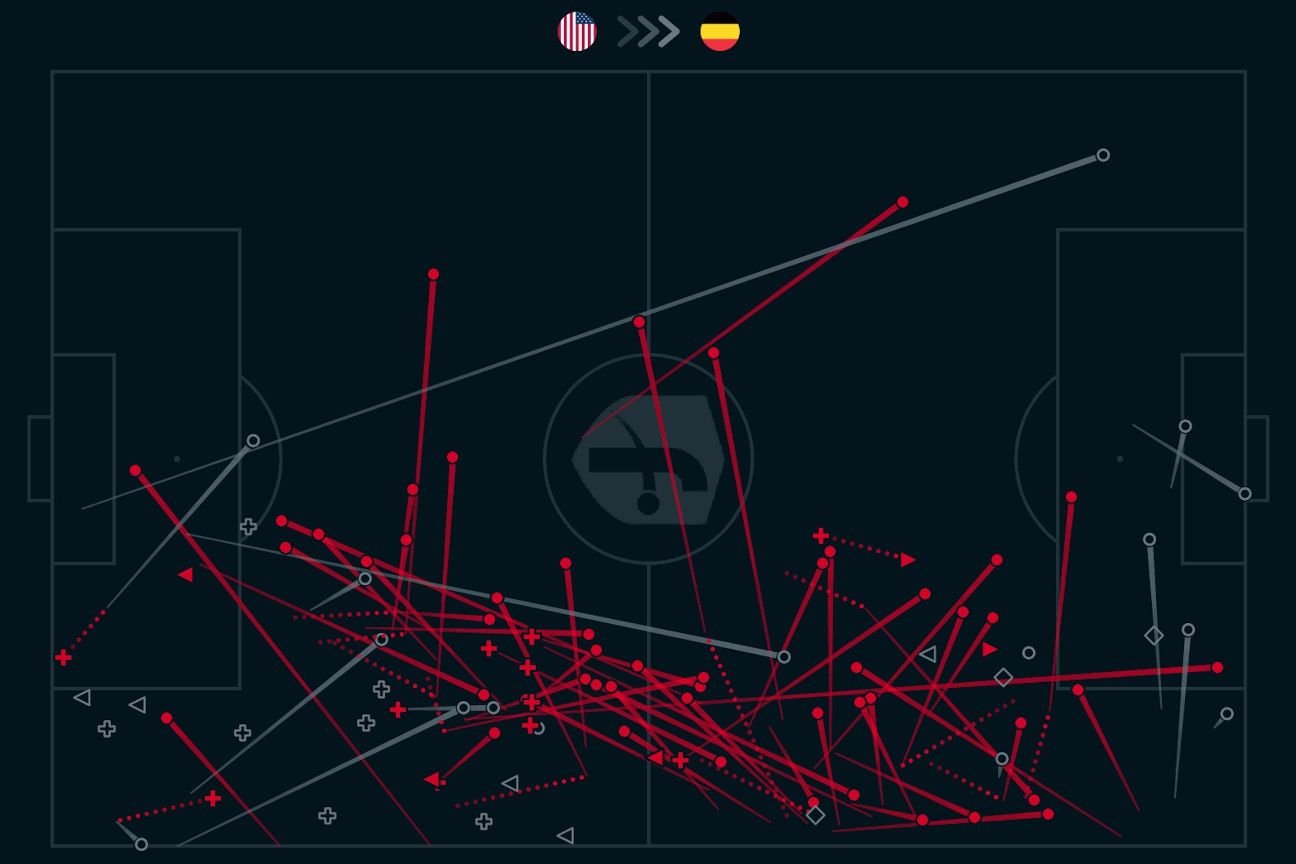
As for Freeman? Actually, he’s a stud, and I thought he was mostly fantastic against Belgium and throughout the tournament. He led the U.S. in progressive passes in the round of 16 with 10, per Futi.
We know he’s a great, versatile, ground-eating defender already. If he has that in his bag consistently too, he’s going to be playing for one of the biggest clubs in the world when we do this again in four years.
This chart below from Futi shows all of Freeman’s actions in the U.S. loss to Belgium. Dotted line: carry. Solid line: pass or shot. Diamond: touch. Upward triangle: take-on. Downward triangle: tackle. Plus sign: interception. X sign: foul. Actions in red were successful; gray ones weren’t.
In the midfield, Adams is at his best when he’s cleaning up everyone else’s messes — he’s not putting his foot on the ball and controlling the tempo. Tillman and McKennie, meanwhile, are players who thrive when they’re around other great players who let them make runs and press high up the field. Neither one is getting on the ball and unlocking opposition backlines or keeping the ball away from the opposition midfield.
Balogun is the best striker the U.S. has ever had, but he’s still not the kind of striker who shifts the game with his presence or provides a star-level combo of playmaking and scoring. No, his fantastic off-ball movement allows him to take advantage of possession dominance or space in behind — two things that get muted when they’re not happening as often.
And then there’s Pulisic, who needs to delete social media and probably unplug his internet for the rest of the summer. There are two interconnected reasons he plays for AC Milan and not a Champions League contender: He’s inconsistent, and he’s frequently injured.
Guess what happened this summer? He had a couple of good halves, had a couple of bad halves and was hampered by a hamstring injury the whole time.
When the U.S. system isn’t creating opportunities — when the talent starts to even out or fall behind — Pulisic is the only American player who can create advantages on his own. When he’s not doing that against Bosnia, it doesn’t matter. When he’s not doing that against Belgium, well, you saw what happened.
If you listen, even managers themselves will tell you that they don’t matter that much.
The legendary Johan Cruyff once said, “If your players are better than your opponents, 90% of the time you will win.” Giovanni Trapattoni — a manager who won the Champions League, Serie A and Bundesliga — put it like this: “A good manager makes a team 10% better, and a bad manager makes it 30% worse.”
Pretty much all statistical analysis ever done on the effects of head coaching agrees with the guys who actually do it.
Ian Graham, Liverpool’s former head of research and one of the people who helped persuade Jurgen Klopp to come to the club, wrote this in his book, “There is some evidence that on the pitch, controlling for the players at his disposal, a good manager can add a few points per season.”
That’s over a 38-game European season, so if we say a good manager is worth five points a season, that would be about 0.13 points per game, or about 1/25th of a win per game. You might think that Pochettino did a bad job preparing the team for Belgium, but 1/25ths of a win worth of coaching isn’t even close to being enough to make up for a three-goal loss where you conceded 15 shots and took only seven.
So, the story remains the same as it ever was. As great as it would be for some special manager to come in, arrange his players just so, make all of the right decisions, find some hidden motivation in everyone on the team and suddenly turn the U.S. into a World Cup contender, that was never going to happen.
One day, the U.S. might finally have world-class talent and might finally need a coach who can give them that final 4% boost that takes it from a team that could win the World Cup to a team that actually does win the World Cup. But if this summer is any indication, that day is still a long way away.
[ad_2]
Credit to: Source link