Thunder’s next test: How far will OKC go to keep its roster intact?


Tim MacMahon
Close
Tim MacMahon
ESPN Staff Writer- Joined ESPNDallas.com in September 2009
- Covers the Dallas Cowboys and Dallas Mavericks
- Appears regularly on ESPN Dallas 103.3 FM
Multiple Authors
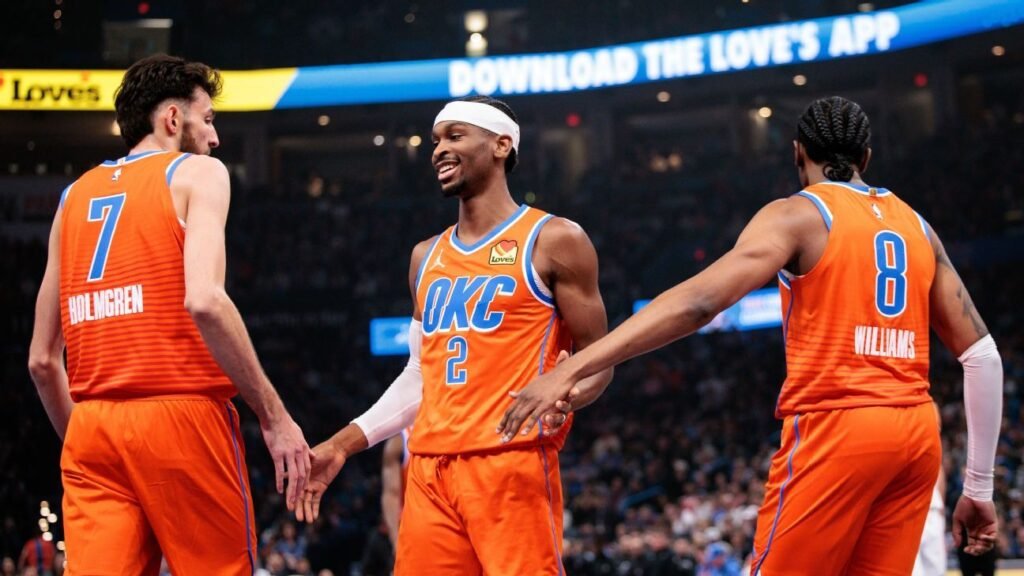
AN HOUR AFTER the San Antonio Spurs dethroned his Oklahoma City Thunder in a dramatic Game 7, Shai Gilgeous-Alexander was asked a version of the question nearly every NBA star gets after his team falls short.
How much input do you plan to have on the franchise’s offseason maneuvering?
“I will give zero input,” Gilgeous-Alexander said. “I will let Sam Presti, the greatest GM ever, do his job.”
The Thunder’s operation is rare in its stability and centralized power structure. Presti was hired at 31 to run the Seattle SuperSonics. He just finished his 19th season in the job, including all 18 years since the franchise relocated to Oklahoma City.
In that time, through the draft and sharp trades, Presti has delivered two of the greatest young cores in NBA history to one of the league’s smallest markets. That has earned him a level of front office autonomy uncommon in sports, rooted in unfettered trust from ownership to the head coach to the fanbase to, in this iteration, the back-to-back MVP entering the middle of his prime.
But as the Thunder dust off the disappointment of a conference finals loss, the spotlight isn’t exclusively on Presti. Keeping an evolving but optimized version of this perennial contender together will require an enhanced financial commitment, shifting an increased obligation onto Clay Bennett and his ownership group to spend what it requires.
Raises follow success. The Thunder just became the sixth franchise since the league shifted to a 16-team playoff format in 1983 to finish as the top seed in three consecutive seasons. They’ve won 57, 68 and 64 games. The middle season ended in a championship. The third, flaming out Saturday night in Game 7 to the 62-win Spurs, could’ve seen another Finals berth had their second-best player, Jalen Williams, not been injured.
Williams and Chet Holmgren, both drafted in the 2022 lottery, signed extensions last summer that kick in starting in 2026-27. Holmgren’s salary is rising from $13.7 million to $41.5 million. Williams’ salary is rising from $6.5 million to $41.5 million.
Additionally, two of the Thunder’s complementary starters enter the summer with contractual uncertainty. Center Isaiah Hartenstein, acquired in the summer of 2024 as one of the finishing pieces to Oklahoma City’s championship puzzle, has a team option for $28.5 million next season. Luguentz Dort, the homegrown, rugged 3-and-D wing who is tied with Gilgeous-Alexander as the longest-tenured players on the roster, has a team option for $18.2 million.
The Thunder’s team salary was a manageable $186.7 million this season, 15th in the NBA and below the tax line for the sixth consecutive season. Next season, prior to the draft, free agency and their various team option choices, the Thunder’s salary is projected at a whopping $250.5 million, well past the projected second apron, which would trigger a more than $200 million tax bill.
League insiders are not predicting the prudent Presti will make any panic moves because of a coin flip seven-game series loss to the Spurs. But many league executives have been wondering aloud for months whether the Thunder’s shifting financials could lead to a slashing and market availability of some of their coveted role players, especially given the cache of draft picks and young players Presti has accumulated to replace them if needed.
“There can’t be room for everybody,” one East executive said.
GILGEOUS-ALEXANDER WON his second MVP this season while making $38.3 million, the 34th-most among all NBA players, behind Trae Young, Domantas Sabonis and Franz Wagner, among others.
Comparatively speaking, the Thunder will have him on an extreme bargain for one more season. He will make $40.3 million in 2026-27, 39th-most among all players before any of this summer’s free agency dealings. His salary is actually a tick below that of Williams and Holmgren ($41.5 million each).
But the big bill is coming.
Gilgeous-Alexander’s four-year extension kicks in for the 2027-28 season, beginning at $61 million and ending with a $75.6 million player option for the 2030-31 season.
Gilgeous-Alexander turns 28 next month. That’s the price of employment for an all-time great guard smack in his prime. But it also generates what league sources believe will be the true beginning — the summer of 2027 — of a financial reckoning for Thunder ownership, testing their appetite to pay what could be a record tax bill to fill out depth around their top three.
Holmgren and Williams, sharing the same agent in Bill Duffy, signed different versions of similar contract extensions last summer. Holmgren’s was a flat 25% max without the opportunity to trigger a spike to 30%.
Williams got the “Rose Rule” provision in his, giving him the opportunity to bump his salary as high as 30% of the salary cap if he had been named All-NBA again in 2025-26.
Injuries, however, derailed that opportunity, hurting the Thunder’s repeat title chances but also saving them long-term money. Williams, who had been a third-team All-NBA selection in 2024-25, was limited to 33 regular-season games and his contract is now locked at the same five-year, $239.2 million rate as Holmgren’s, instead of reaching the $287 million total and the extra tax dollars that would’ve been attached if he would have been a first-team selection. The salary would have escalated to 26% of the cap if he were a third-team selection, 27% if he was second-team choice.
Williams has an important summer in front of him, admitting Sunday afternoon that he is still trying to solve the hamstring injuries that derailed his fourth season. He strained his right hamstring twice in the regular season and his left hamstring twice in the playoffs.
“[It] sucked,” Gilgeous-Alexander said of the absence of his costar. “He’s just such a unicorn out there, a 20-point per game scorer, guards 1 through 5. … Having that on the court 24/7 is just a luxury, and we just didn’t have that luxury this year.”
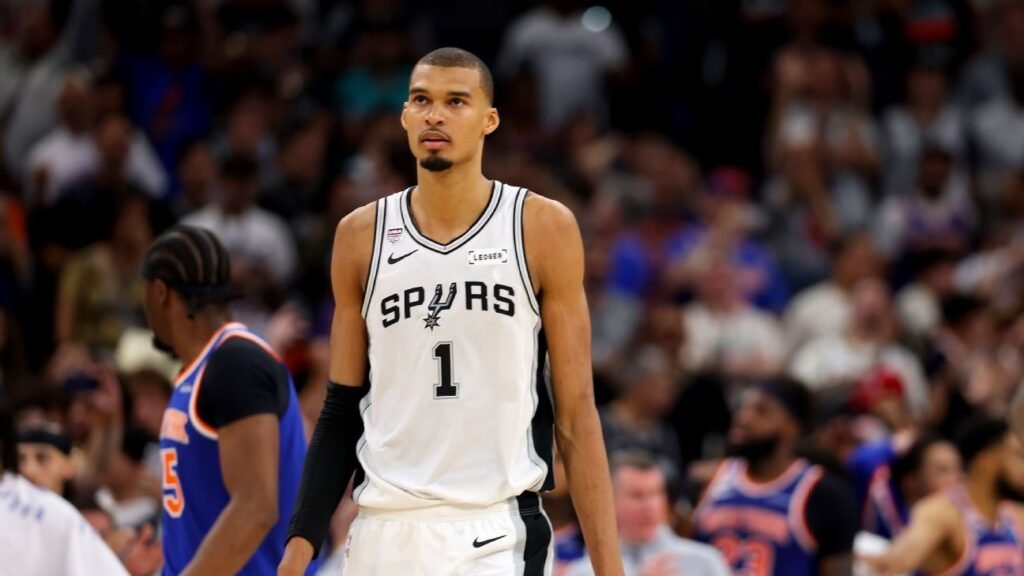
Without Williams, Holmgren wasn’t able to ease Gilgeous-Alexander’s offensive burden in the San Antonio series. Facing a wave of wings closing out hard and attacking his dribble while Victor Wembanyama loomed, Holmgren struggled to operate in the half court.
Holmgren averaged only 7.3 shot attempts in the seven games and took only three total 3s in the final four games of the series despite the need to stretch the floor against Wembanyama. He was a nearly silent 1-of-2 shooting for four points in Game 7 — and both of his field goal attempts came in the game’s opening few minutes.
“I feel like there were definitely opportunities to get more attempts up that I didn’t in the moment,” Holmgren said. “That’s an area to improve.”
This continued a downward trend in Holmgren’s volume on the perimeter. His 3-point attempts have decreased from 4.3 to 3.6 to 3.5 in his three seasons and were only at 2.8 in these playoffs. Thunder coach Mark Daigneault called it a multilayered problem but did say it was a “priority” to correct that trend. Gilgeous-Alexander backed him.
“When he’s the best version of himself, we’re the best version of ourselves,” Gilgeous-Alexander said. “It’s no secret. We need Chet. … I didn’t perform my greatest this series either.”
Holmgren finished second in Defensive Player of the Year voting and was an All-NBA third-teamer. He had a big second-round series against the Los Angeles Lakers — he averaged 20 points and 9.8 rebounds — and is still backed internally as a franchise pillar entering the front stages of his prime.
Gilgeous-Alexander, Williams and Holmgren made a combined $58.5 million this season. It moves to $123.8 million next season and $150.8 million in 2027-28, the same season that a theoretical extension for Cason Wallace, who can sign a deal this summer, would trigger.
2:36
Stephen A.: Chet Holmgren should be traded for someone like Giannis ASAP
WHILE HOLMGREN UNDERWHELMED and Williams was mostly unavailable in the conference finals, the Thunder’s role players showed why they’re so important to the team — and why the cost of keeping them might become prohibitive.
Hartenstein, Dort and Alex Caruso all reiterated a desire to stay with the Thunder during their exit interviews.
Caruso, entering the second season of a four-year, $81 million extension, is considered a firm member of the long-term core, league sources said, proving again his extreme playoff value the past month in the locker room and on the court.
Hartenstein and Dort also remained beloved organizationally, but their team options demand a more urgent decision — opt them into an expiring, opt them out, trade the number at a positive market value or work out a decline-and-extend at a lower starting number.
There is a strong anticipation among team and league sources that Hartenstein will be back in Oklahoma City next season, whether the Thunder choose to pick up his team option or the sides agree to an extension. With Wembanyama and the Spurs looming as a long-term rival, it would be a significant step in the wrong direction for the Thunder to thin out their big man depth, especially after Hartenstein had some success defending Wembanyama during the West finals.
The decision on Dort is considered murkier, in part due to Wallace’s presence as a potential replacement in the starting lineup who is in line for a significant raise, starting in the 2027-28 season. While Gilgeous-Alexander publicly vowed not to provide input to Presti on personnel matters, sources familiar with the superstar’s thinking said that he privately intends to emphasize to management how much he values playing alongside Canadian countryman Dort. Dort switched agents from Thaddeus Foucher to Klutch Sports’ Mike George this season, a move that hardly signifies a willingness to accept a team-friendly deal.
Executives with other teams are also monitoring whether the Thunder could seek to trade other players to shed salary and limit the luxury tax bill — or simply make room on their roster. Including the three players with team options — Hartenstein, Dort and Kenrich Williams — Oklahoma City has 15 players under contract for 2026-27, plus two first-round picks in this month’s draft, both of whom would receive guaranteed contracts if the Thunder made both picks.
The most likely candidates to be moved in a trade to rebalance the roster are Isaiah Joe and Aaron Wiggins, who have proved to be quality role players but fell out of the rotation during these playoffs. Joe is due $11.3 million next season and has a team option at the same salary for 2027-28. Wiggins is due $9.2 million next season and $8.3 million in 2027-28 with an $8.3 million team option in 2028-29.
Kenrich Williams, another quality role player who has been in and out of Oklahoma City’s deep rotation, has a team option for $7.2 next season. Rival executives anticipate that the Thunder will decline that option, although Williams could return at a reduced salary.
That trio combined to average 10.7 points in the conference finals. OKC has recent first-round picks Nikola Topic and Thomas Sorber waiting in the wings should some role players need to be shed for cost purposes.
One major factor in this series of decisions will be the financial pain threshold level of Bennett and the ownership group. With three additional first-round picks plus a pair of swaps in their treasure chest, the Thunder won’t be as impacted by second-apron ramifications such as the freezing of their own future first-round pick.
The Thunder, who own the 12th, 17th and 37th picks in the upcoming draft, are expected to be active in trade discussions during the draft. League sources said they’ve had exploratory discussions with teams in the top 10 about what it could take to move up, the type of trade that is typically dependent on a specific target still being available when a pick goes on the clock.
“The second apron has become so ingrained in our NBA vocabulary so quickly,” Presti said during the preseason. “But there’s nothing relative to the second apron that would prohibit us from keeping anyone on our team.”
THE LAST TIME Presti sat in front of a microphone, he spoke for 127 minutes. It was in September, prior to training camp. Buried within the state of the franchise address, he gave an extended answer on the organization’s ability to deal with the incoming tax bills.
Presti called the ownership group “fiercely committed” to supporting the team and aware of what is on the horizon.
“We knew five years ago when we repositioned and replenished the team that if we were to ever get back to the postseason or exceed past being just an average playoff team, we would need the resources to support that,” Presti said. “We saw that during the first mountain. This isn’t our first look at this. There’s been ample time for us to plan for this and we have the benefits of some outside resources that should aid us.”
That “first mountain” is in reference to the Kevin Durant and Russell Westbrook iteration. Early in their climb, after the 2012 Finals appearance, they made the infamous James Harden trade. Minor negotiation differences and an avoidance of the tax led to a transaction that partly defined an era that, while spectacular, ended without a title.
Bennett’s ownership group later green-lit a $25.4 million tax bill in 2017-18 and a $61.3 million tax bill in 2018-19 as the Thunder chased the fading days of that contention window, an indication of their willingness in certain circumstances.
When Presti “repositioned” the Thunder for the current era, he throttled back the team’s salary. In the lean seasons — 2020-21 and 2021-22 — they dropped from $133.5 million to $95.6 million and $80.9 million, 30th in the NBA both years.
That laid initial groundwork for the financing ahead. In the past six seasons, they’ve spent $829.9 million on the roster, fourth lowest in the NBA. In the past three seasons — the beginning of the contention window — they’ve spent $507.2 million, 12th lowest while leading the league in wins, injecting the type of brand benefit and capital attached to success (playoff gate, merchandise) without paying a normal rate.
“We won’t hit any type of repeater [tax] penalties until we’re in another CBA,” Presti said. “We’ll be in a new arena by the time we’re hitting any repeater tax penalties.”
The additional luxury tax penalties for repeat taxpayers don’t kick in until a team has paid the tax in three of the previous four seasons, so the earliest the Thunder could face those penalties is the summer of 2029, one season after OKC gets a potential revenue boost.
In December 2023, Oklahoma City voters approved a new $900 million arena and agreed to pay $850 million of it through a 72-month one-cent sales tax. That left a $50 million bill for the Thunder’s ownership group, significantly less than they’ll pay Gilgeous-Alexander annually in all four seasons of his recently signed extension.
Construction has already begun on the new arena, which is projected to open for the 2028-29 season. Presti called its eventual arrival a “significant driver of revenue” for the organization and also mentioned the league’s new TV deal and possible expansion — domestically and in Europe — as beneficial to the grander plan.
“We’re positioned well to have a significant influx of capital going forward during a period of time where for sure our team is going to get more expensive,” Presti said.
[ad_2]
Credit to: Source link