How Titans’ Saleh is living father’s dream as an NFL coach

NASHVILLE, Tenn. — Robert Saleh almost veered away from football when he was first introduced to the game at the age of 7. He was afraid because he was, as he described, “a little soft” when he first started.
The turning point for the Tennessee Titans’ newest head coach came during an “Oklahoma drill” when he was 9 in Dearborn, Michigan. The controversial drill puts players in a one-on-one matchup designed to test a player’s toughness and blocking/tackling techniques.
Robert used to say his stomach hurt when it was time to do that drill, which the NFL asked teams to stop conducting in 2019 to reduce concussions, so he didn’t have to participate. But this time was different — as the head coach of the Pop Warner team that was running the drill just happened to be his father, Sam.
So Robert refused to back down.
“My dad was sitting there with a ball in his hands, getting ready to hike it,” Robert told ESPN. “And that was the moment I was like, ‘I am not turning this down.’ I didn’t want to look like a wimp in front of him.”
The Salehs are a close-knit family of Lebanese descent that takes pride in their heritage.
“My father was probably the first from the Arab American community in Dearborn to really start playing football and make a mark,” Robert’s older brother David told ESPN. “A lot of people grew up wanting to be like him on the football field. So with that, you always want to be like your dad.”
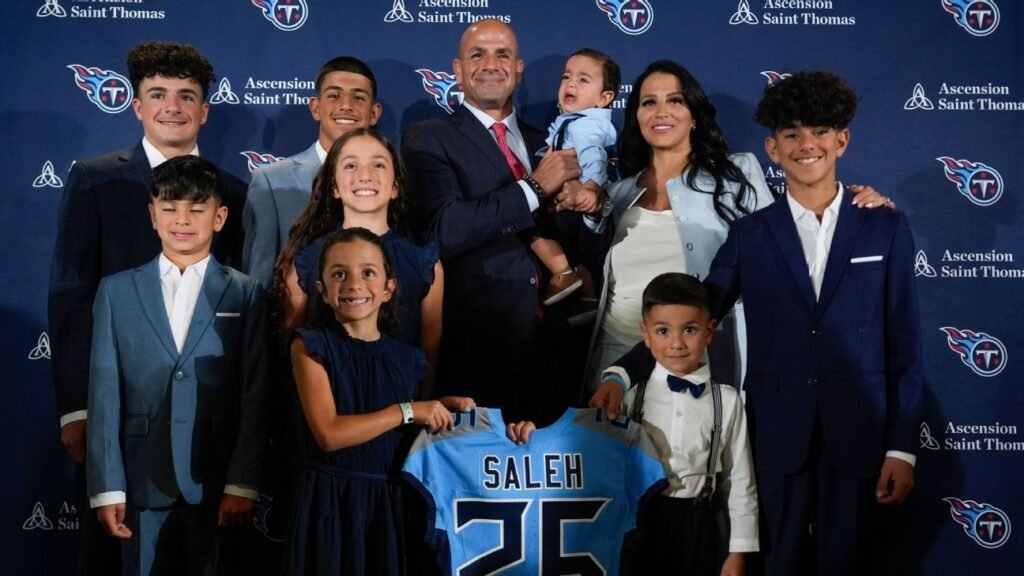
Robert’s football journey is one that has traversed firings and promotions, losses and Super Bowls. It culminated recently when Sam — along with Robert’s wife, Sanaa, and their eight children — had front-row seats on Jan. 19 as Robert was named head coach of the Titans.
“My dad always talked about how he wished he had stayed in coaching,” Robert said.
Still, Sam didn’t immediately embrace Robert’s dream to become a coach. Robert had a banking job, and Sam knew how hard it would be to climb the coaching ladder. But as he listened to his son articulate his vision, Sam could see the passion wasn’t going to be denied.
“I’m looking at him, and he was speaking with such conviction,” Sam said. “I told him it’s not what you think it is.”
SAM WAS A standout middle linebacker at Fordson High School. He went on to play at Eastern Michigan before he earned a tryout with the Chicago Bears. A severe knee injury during his first training camp ended his professional career, and he would later go into construction.
Sam wanted to get into coaching, but he had a bigger calling to provide for his wife and their son, David, at the time.
Still, his deep love for football influenced Robert, now 47. David, 50, never got to play for their father, who was focused on making sure his family was financially secure.
“My dad was instrumental for Robert,” David said. “He was at my games and whatnot, but he was never one of my coaches because he was pounding pavement [looking for a job], grinding it out and trying to make a great life for us. But with Robert, he was able to coach him and be more involved.”
Robert would become a four-year starter and all-conference selection at Northern Michigan. but playing in the NFL wasn’t in Robert’s future. So he landed a job with Comerica Bank, where he was making $800 per week evaluating loan applications after graduating in 2000. He was in a position to eventually earn a six-figure salary, but something was missing.
However, everything changed for the Salehs on the morning of Sept. 11, 2001, when two planes struck the World Trade Center in New York. David had started working for Morgan Stanley two days prior. His office was on the 61st floor of the south tower, where he was training to be a financial adviser.
The Saleh family was left to watch the tragedy unfold on television with the rest of the world. With David’s status unknown, they feared the worst, but he made it out — immediately fleeing after seeing the first plane strike the north tower. David called his family to let them know he was alive after arriving at his hotel in Times Square.
That moment of uncertainty, not knowing if his brother survived, inspired Robert to pursue his passion. It made him realize that tomorrow isn’t promised.
“It was at that moment I realized I cannot sit another year working a 9-to-5 without having a purpose other than money,” Robert said.
SAM TRIED TO talk his son out of coaching — knowing Robert would have to start from the bottom. He remembered how the graduate assistants were “gopher guys” when he was at Eastern Michigan. Sam said they had to make coffee runs, work a printer and perform other tedious tasks.
Sam eventually came around, though. He knew Robert was young and single, so if turning to football proved to be a mistake, he could recover.
So at 23, Robert took the leap of faith and left the banking industry. He told himself that if coaching didn’t work out by the time he was 30, he’d have to find another way to make a living.
Robert began his coaching career making $600 a month as an offensive assistant working with the tight ends at Michigan State in 2002. He switched to a defensive assistant in 2003 and worked with the defensive line before moving on to become a graduate assistant at Central Michigan in 2004. Robert was a defensive assistant (linebackers) in his final collegiate coaching season at Georgia in 2005, where he was making $900 per month.
Money was tight, but he always had his parents to support him while he worked through the coaching ranks, especially his mother, Fatin.
“They were a huge help,” Robert said. “Anytime I came back home, I always found a couple hundred bucks left in my shoe from my mom.”
While Sam helped inspire Robert to get into coaching, Robert states that his wife is the lifeline that helped sustain it. Moving from city to city as opportunities arise is challenging. It’s an even more daunting task with their eight children — Adam (15), Zane (13), Sammy (12), Mila (10), Michael (9), Ella (7), Jacob (5) and Robert Jr. (1).
“I got an unbelievable wife,” Robert said. “She’s already got a place in heaven. Most beautiful heart, most beautiful person. She makes it easy. We’re already in a stressful environment, and she makes sure when we get home, it’s stress-free.”
Robert manages to take his children on a rotation to sneak in nine holes so they can hang out while he teaches them golf. It’s Robert’s way of following the example Sam set when he taught his kids chess at a young age.
WHEN SALEH WAS a defensive quality control coach for the Seattle Seahawks in 2011, he met Gus Bradley — who was the defensive coordinator before becoming the head coach for the Jacksonville Jaguars in 2014. Bradley brought Saleh to Jacksonville with him to be the linebackers coach.
One thing Bradley always emphasized was balancing family life with football. Part of that balance has been allowing his kids, along with those of the coaches, to come to practice during training camp.
Bradley, now the defensive coordinator for Saleh in Tennessee, smiled as he described how cool it was for him to see Saleh’s oldest getting the chance to catch passes from Cam Ward before practice.
“With the number of kids he’s had, you have to be efficient,” Bradley said. “He does a great job balancing, far better than a lot of people I know. But it’s never at the expense of one or the other. He’s always been heavy deep into football and a great father.”
In 2017, Saleh would join the San Francisco 49ers as their defensive coordinator under coach Kyle Shanahan. After three successful seasons there, including a Super Bowl appearance in 2020, Saleh was named head coach of the New York Jets in 2021 — making him the first Muslim head coach in NFL history.
“Robert is a great role model and spokesperson for us,” David said. “To be able to look at America’s game and a Muslim man is sitting on the pinnacle of it, one of 32 [NFL head coaches] in the world; he’s a hero in our community. So many kids look at him and say, ‘See, that he can do, so can I.’ I’m really proud of him.”
Things didn’t go as well in New York as the Saleh family would have hoped, ending with Saleh being fired after starting the 2024 season with a 2-3 record. He went 20-36 overall. Saleh finished the season as an assistant with the Green Bay Packers and went back to San Francisco as the defensive coordinator in 2025.
Now he’s getting his second chance at being a head coach, and Sam proudly watched from the first row as Robert thanked his family for being by his side throughout his introductory news conference in Nashville.
“It was like a dream,” Sam said. “A very emotional moment, like ‘Wow, look at my son. He is in the NFL. He’s a head coach!'”
[ad_2]
Credit to: Source link