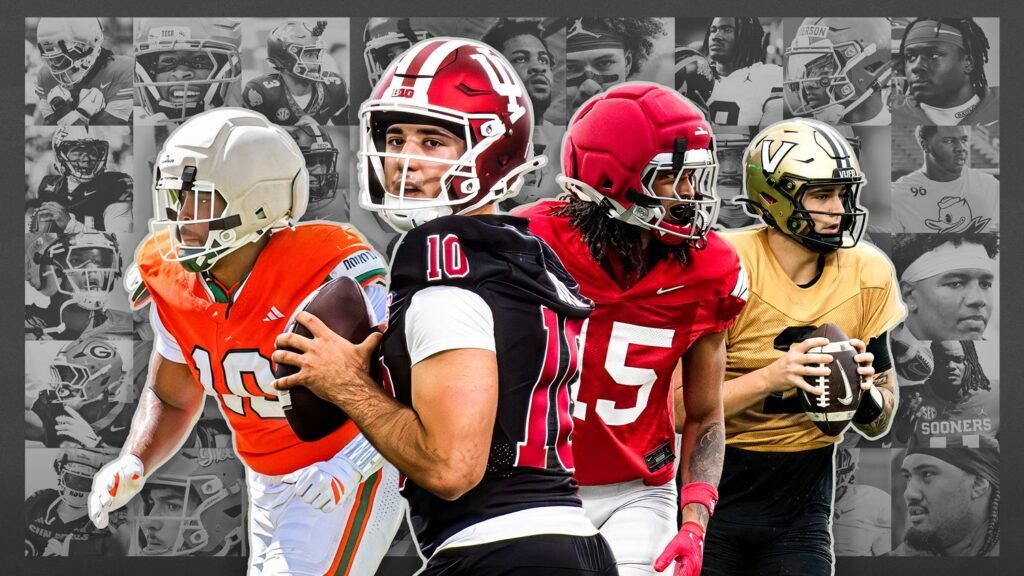
2026 Mountain West Conference college football preview and predictions













Bill Connelly
Multiple Authors
Survive and advance. It’s the name of the game if you’re in the throes of March Madness, and it’s the name of the game if you’re an athletics conference.
The Mountain West seems to have as many what-ifs as any major conference: It briefly looked like it could benefit significantly from the conference realignment wars of the early-2010s but instead lost BYU, TCU and Utah. It looked like it might benefit from the Pac-12’s demise and become the premier Western conference in college sports — and teased me with the thought of a tiered conference with relegation — but instead the Pac-12 used the power of its name and intellectual property to pull itself back together and take some of the MWC’s sturdiest football programs (Boise State, San Diego State, Fresno State). But what do you do? Survive and advance. The MWC held onto a rising UNLV program and grabbed UTEP, Northern Illinois and FCS powerhouse North Dakota State, and on we go.
In terms of average projected SP+ ratings, the Pac-12 will hold the advantage in 2026, but the MWC might be the second-best conference in the new Group of 6. UNLV and a suddenly exciting New Mexico will lead the way out of the gate, but the addition of NDSU adds all sorts of intrigue. (It only took former FCS power James Madison four years to reach the CFP. Can the Bison do it in three??) With a potential rebound from Air Force and the hope of a continued rise from Hawai’i, the Mountain West should be awfully fun to watch even if the lowest-rated teams are as poor as expected.
Let’s preview the MWC!
2025 recap
Technically, SP+ helped to decide the MWC title in 2025. When SDSU, Boise State, UNLV and New Mexico all finished 6-2 in conference play, with an incomplete set of head-to-head results between them, the MWC had to go to the scorecards – or in this case, the computer rankings. Boise State and UNLV got the nod, and BSU won its 11th straight over the Rebels to take the title in its final season in the conference.
Continuity table
The continuity table looks at each team’s returning production levels (offense, defense and overall), the number of 2025 FBS starts from both returning and incoming players and the approximate number of redshirt freshmen on the roster heading into 2026. (Why “approximate”? Because schools sometimes make it very difficult to ascertain who redshirted and who didn’t.) Continuity is an increasingly difficult art in roster management, but some teams pull it off better than others.
With six wins in a row to end the regular season — and a super-tight loss to Minnesota in the Rate Bowl — New Mexico finished the season as the conference’s hottest team. Now the Lobos return the most production in the conference as well. That certainly establishes them among the most likely contenders. Air Force could be well-positioned, too, at least if the Falcons can start defending again at some point.
UNLV survived spectacular turnover last season to still play at a high level, and as long as a marquee QB transfer clicks, Dan Mullen’s Rebels should be able to survive another round of turnover to lead the way.
2026 projections
UNLV indeed starts out atop the pile, but in terms of SP+ ratings, five teams are within just 6.6 points of each other at the top. Hawai’i and Air Force could turn into serious threats with only a little bit of overachievement.
UNLV must play at New Mexico, Air Force and Hawai’i, but the Rebels still hold enough of an overall ratings advantage to start out as the most likely contender. And with trips to all four of the other primary contenders, NDSU is getting some serious “Welcome, newbie” treatment from the MWC’s schedule-makers.
Five best games of 2026
Here are the five conference games that feature (a) the highest combined SP+ ratings for both teams and (b) a projected scoring margin under eight points.
Sept. 5: UNLV at Hawai’i. With UNLV playing on the road against three other possible contenders, that probably tells you what a lot of this five-game list is going to look like. But the gauntlet starts immediately. After hosting a talented and rather unknown Memphis team in Week 0, the Rebels will head to the islands for Week 1. Jackson Arnold and other newcomers better be up to speed from the start.
Oct. 10: North Dakota State at UNLV. NDSU faces a mid-September trip to Air Force, but this should be the big measuring-stick game for the Bison. Does their physical style translate to immediate contention?
Oct. 17: UNLV at Air Force. UNLV’s 51-48 win over Air Force last season was one of the most delirious and entertaining games of the season. I request a repeat.
1:18
Air Force Falcons vs. UNLV Rebels: Full Highlights
Air Force Falcons vs. UNLV Rebels: Full Highlights
Oct. 24: North Dakota State at New Mexico. We don’t get a Dakota Marker game this season, but we do get former South Dakota State assistant Jason Eck and New Mexico hosting NDSU right around the same time of the year. That sort of counts, right? Dakota Marker proxy game?
Nov. 14: UNLV at New Mexico. It wouldn’t surprise anyone if this was the first of two late-season UNLV-UNM games. The winner of this one might host the next one – the conference title game.
My five favorite transfers
QB Jackson Arnold, UNLV. A former five-star prospect, Arnold failed to turn frantic energy and athleticism into actual, sound QB play at either Oklahoma or Auburn. He scrambled his way into countless sacks (and didn’t get all that much help from his lines either). But if anyone can turn speed and a solid arm into actual output, it would be Dan Mullen and offensive coordinator Corey Dennis.
CB Yassine Falke, NIU. There are some dynamite athletes down in NAIA, and NIU might have found one in Falke. The Marian (Indiana) transfer stands 6-foot-3 and picked off five passes with 14 pass breakups in his first full season in the lineup. And he might have done a couple more games’ worth of damage had Marian not been disqualified from the NAIA playoff for inadvertent ineligibility issues.
LB Cam Santee, UNLV. There are some dynamite tackling-machine linebackers in FCS, and UNLV grabbed one in Santee, who made 110 tackles and 14 tackles for loss, with five forced fumbles and five pass breakups, in 12 games at Holy Cross. The last Holy Cross-to-UNLV transfer left under odd circumstances, but I’d be surprised if this one didn’t work pretty well.
S Will Hicks, New Mexico. Jason Eck has used his Big Sky ties to great effect at UNM, but he reached east to grab this 6-foot-2, 195-pounder from Hampton, who made 72 tackles with six TFLs, an interception, four pass breakups and two forced fumbles last season. A stat collector.
P Brady Braun, UTEP. Punters don’t show up frequently on these Favorite Transfer lists, but I’ll make an exception for a guy who averaged 48.1 yards per kick at Gardner-Webb last season. He had 13 punts of 50-plus yards with eight downed inside the 20 and no touchbacks. No touchbacks! And where better to ply your trade as a punter than at a school that averaged 5.2 punts per game last season?
Conference title (and, therefore, CFP) contenders
Head coach: Dan Mullen (second year, 10-4 overall)
2026 projection: 59th in SP+, 8.7 average wins (5.8 in the MWC)
I get that there are more games now, so it’s easier to rack up bigger win totals, but this is still pretty incredible:
Total nine-win seasons for UNLV, first 45 years in FBS: 2
Total nine-win seasons for UNLV, last three years: 3
From 1985-2022, the Rebels finished with a winning record only five times. But here they are, the sudden heavyweights of a new Mountain west.
Both UNLV and Mullen proved a lot last season. The Rebels ranked in the nation’s bottom 10 in returning production after winning 11 games in 2024, but Mullen made the most of returnees like running back Jai’Den Thomas and linebacker Marsel McDuffie and fattened up the two-deep with plenty of exciting transfers. There are plenty of new holes to fill this year — quarterback Anthony Colandrea, leading receiver Jaden Bradley, McDuffie, seven of the top eight linemen and four of the top five DBs are all gone — but the challenges seem more manageable, and the portal seemingly brought the Rebels quite a few new goodies.
It starts at quarterback, where Mullen’s gamble on Jackson Arnold needs to pay off. In terms of pocket presence, his internal clock was completely broken last year, as he took at least four sacks in four games and took nine against Oklahoma. His Total QBR was above 85.0 four times and below 45.0 six times (and never in between). If Mullen and Corey Dennis can simply cut down Arnold’s negative plays, the Rebels will score plenty of points.
While the receiving corps is taking on major turnover, Thomas’ return after producing 1,273 yards from scrimmage last season is huge. Thomas and Arnold running behind a line that returns both starting tackles and added starting guards from New Mexico State (BJ Tolo) and Appalachian State (Griffin Scroggs) is a pretty good starting point. New targets will need to emerge — the best portal additions: slot Taz Reddicks (Oregon State) and tight end Keyan Burnett (Arizona) — but UNLV should run the heck out of the ball.
If this team falls short of expectations, the defense is the likely reason. The Rebels fell from 55th to 89th in defensive SP+ last season, then got wrecked by attrition for a second straight year: Of last year’s 19 defenders with 200-plus snaps, only six return, and four are in the secondary. Mullen added only one defensive line transfer (Tennessee’s Herb Gray), which hints at confidence in his talent pipeline, but there’s almost nothing proven up front. Linebacker is less of a concern thanks to the return of junior Blesyng Alualu-Tuiolemotu and senior Kamuela Ka’aihue and the addition of FCS tackling machine Cam Santee (Holy Cross). And grabbing nickel Kyron Chambers (SMU) and safety Landyn Cleveland (Oklahoma State) — both of whom started games for power conference programs last season — was exciting. But if the Rebels don’t hold up in the trenches, it could derail all plans.
Head coach: Jason Eck (second year, 9-4 overall)
2026 projection: 68th in SP+, 8.0 average wins (5.3 in the MWC)
A Big Sky team won last year’s FCS national title, and a Big Sky all-star team nearly won the Mountain West. OK, yes, there’s some literary license in that sentence, but behind head coach Jason Eck (who previously coached at Idaho), a lineup including quarterback Jack Layne (Idaho), running back Damon Bankston (Weber State), defensive end Keyshawn James-Newby (Idaho), linebacker Jaxton Eck (Idaho) and corners Frankie Edwards III (Weber State), Jon Johnson (Montana State) and Abraham Williams (Idaho) won its last six regular season games to go from 3-3 to 9-3 and land in a four-way tie atop the MWC.
On offense, the run game was sound (despite three freshman or sophomore starters on the line), third downs were manageable, and Eck knew when to go for it on fourth down. Meanwhile, the defense just kept improving as the year went on, especially against the run and in the pass rush. After enjoying just two winning seasons in the 17 previous years, the Lobos became one of the nation’s more delightful stories.
The odds of a happy encore are solid, as the Lobos have the second-best returning production in the Group of 6. Layne and four starting linemen return, including center Kaden Robnett, an all-conference selection as a freshman. Eck had to bring in quite a few skill corps transfers after losing his top two rushers and top three pass targets, but grabbing running back Kiefer Sibley (6.1 yards per carry at North Texas) and receivers Troy Omeire (16.6 yards per catch at UNLV) and Miles Williams (524 yards at Eastern Washington), among others, was solid work.
The defense should hold up if new pass rushers emerge, but there’s a high bar in that regard after the loss of James-Newby and Brett Karhu (combined: 16.5 sacks). None of the returnees came close to those two players’ high pressure rates, and incoming transfers Clay Martineau (Boise State) and Jalen Charles (Memphis) are athletic but are both untested sophomores.
Everything else looks sound. The Lobos appear deep at tackle and safety, and in between, Jaxton Eck (128 tackles, 7.5 TFLs, 18 run stops) is the league’s best linebacker. Fellow linebacker Mercury Swaim is excellent, too. Two of last year’s top three corners (Williams and Edwards) are back, and Eck added transfers Ormanie Arnold (Cincinnati) and Eric McClain (Ball State) to the mix, too.
A year ago, New Mexico was the lowest-projected team in the league. Now the Lobos are projected underdogs only twice — by 20.2 points at Oklahoma in Week 3 and by 0.7 points against UNLV in November. It doesn’t take long to reverse fortunes these days, and Eck did it in a heartbeat in Albuquerque.
Head coach: Tim Polasek (third year, 26-3 overall)
2026 projection: 72nd in SP+, 8.4 average wins (5.1 in the MWC)
Missouri State and Delaware immediately went 7-6 in FBS. Liberty is 65-35 overall. Jacksonville State won nine games in its first season, and Kennesaw State and Sam Houston each won 10 in their second. James Madison almost immediately became the best program in the Sun Belt.
It doesn’t usually take long for FCS programs to establish themselves in FBS. And none of the programs who jumped thus far were North Dakota State.
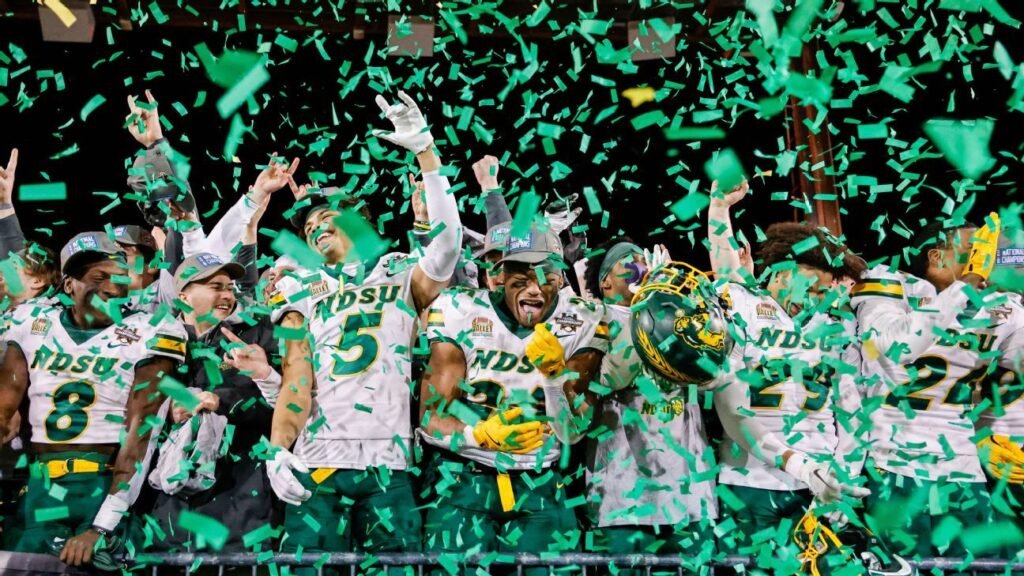
The Bison joined FCS in 2004, and they ran it by 2011. They won 10 of the last 15 national titles. According to SP+, they’d have had a top-50 team in FBS on quite a few occasions. It’s going to be difficult to contain expectations.
I do have to wonder, though, if it would have been better for them to jump last season. The Bison had dynamite quarterback Cole Payton, one of their best receivers ever in Bryce Lance (brother of Trey) and, on paper, their best team in years. They outscored opponents 42.2 to 11.7 before a stunning upset loss in the playoffs. But their first FBS team will have a new starting quarterback, a mostly new skill corps and a mostly new secondary.
They’ll still have linemen, though. They always do. Star guard Griffin Empey returns, as do a number of other sophomores and juniors who played at a high level in 2025. On defense, most of last year’s tackles return, led by junior Keenan Wilson, but with the top two pass rushers gone, former backups Victor Isele and Matthew Stenbroten or Anthony Okes (13 TFLs at NAIA Montana Tech) will need to provide some punch.
Fifth-year senior Nathan Hayes will take the reins at QB. It’s fair to wonder about his ceiling as a career backup, but maturity should create a solid floor. Running back Barika Kpeenu, who rushed for 20 touchdowns in 2025, is gone, but juniors DJ Scott and Cortez LeGrant had almost exactly the same per-carry averages. The receiving corps might be a concern, though. Including Lance, six of the eight players with more than six catches are gone, leaving only slot man Jackson Williams, sophomore tight end Reis Kessel, little-used power-conference veterans Jordan McCants (West Virginia) and Jeremiah Patterson (Arizona) and unknowns. Someone will need to punish defenses on play-action.
I like the way Tim Polasek dealt with the other primary roster hole: At cornerback, he added both sixth-year senior Chance Tucker (Notre Dame) and a pair of Division II stars in DJ Voltz (Saginaw Valley State) and EJ Davis (Wayne State-Nebraska). I don’t have many defensive concerns.
NDSU’s FBS journey starts with old friend Jacksonville State visiting the Fargodome in Week 1. (JSU beat the Bison twice in the D-II playoffs, but NDSU walloped the Gamecocks in the 2015 FCS title game.) Wyoming, Nevada, UTEP and NIU will also visit. If NDSU fans were bored in FCS, they certainly won’t be now.
Head coach: Troy Calhoun (20th year, 139-97 overall)
2026 projection: 79th in SP+, 7.8 average wins (5.2 in the MWC)
Fall apart, then come back together stronger than ever. In 19 seasons at Air Force, Troy Calhoun has followed that path repeatedly. After a run of SP+ top-60 performances from 2007-11, the Falcons slipped in 2012, then plummeted to 2-10 and 109th in 2013. Then they won 10 games in 2014 and 2016. They went 5-7 in back-to-back seasons in 2017-18, then went 11-2 in 2019 and 10-3 in both 2021 and 2022. There are no shortcuts when you can’t redshirt players or take on transfers, so the fixes might take a minute. But Calhoun always finds them.
I think we started to see another fix last season. After plummeting to 5-7 and 111th in SP+ in 2024, the Falcons slipped further, to 4-8, last fall, but that was due in part to a 1-3 record in one-score finishes. As soon as quarterback Liam Szarka established himself in the lineup, the offense was fixed: In the eight games in which he saw over 40 snaps, Air Force averaged 31.0 points per game. (In three other games against FBS opponents, they averaged just 20.3) He averaged 5.4 yards per carry with an excellent 50.8% success rate in the run game, and of his 75 completions, 21 gained at least 20 yards. With Szarka, 750-yard fullback Owen Allen, two offensive line starters (plus two other linemen who saw over 250 snaps) and at least one big-play receiver (Jonah Dawson) back, this could be Air Force’s best offense in years. The Falcons haven’t finished in the offensive SP+ top 50 since 2019, but I give them a puncher’s chance.
Now they just need to get the defense back in order. After four consecutive defensive SP+ top-30 finishes, they slipped to 76th in 2024, then 101st last season. They just couldn’t figure out any sort of balance: The run defense slipped, and passing downs were an absolute disaster: They ranked 19th in blitz rate but 119th in sack rate.
In outside linebacker Isaac Hubert, the Falcons have one absolute star. They need more. Virtually the entire linebacking corps returns, and while last year’s secondary was loaded with freshmen and sophomores, they’re sophomores and juniors now. (Sophomore safety Max Mustell could be excellent soon.) But the defensive front, a weakness last season, lost its top four guys. And again, transfers aren’t an option. They’ll need a developmental miracle to start providing a push up front again. With Szarka, they could win some track meets in 2026, but without a better defensive front, contention might be a lot to ask.
Head coach: Timmy Chang (fifth year, 22-29 overall)
2026 projection: 84th in SP+, 7.3 average wins (5.0 in the MWC)
I began this offseason by predicting Hawai’i to reach the CFP. Granted, it came with a little bit of snark — the CFP committee only deigns to consider mid-majors if they were lucky enough to schedule multiple power conference opponents, and Hawai’i did that — but there was a grain of truth in there, too.
After three years of slow foundation building, Timmy Chang’s Rainbow Warriors took a big step forward in 2025, from 5-7 and 107th in SP+ to 9-4 and 68th. And while they’re certainly dealing with quite a bit of turnover — they basically return four offensive starters, three defensive starters and only 12 of the 32 players who saw 200-plus snaps — a lot of the right guys are back. Quarterback Micah Alejado threw for 3,106 yards and 24 TDs as a redshirt freshman despite being hobbled for a good portion of the season, and go-to slot man Pofele Ashlock is back as well. The offensive line returns three big, experienced seniors, and the defense returns a solid end in junior Lesterlaisene Lagafuaina, a sideline-to-sideline linebacker in Jamih Otis and one of the best nickel backs in the Group of 6 in senior Elijah Palmer. Despite measuring in at 5-foot-8 and 180 pounds, Palmer made nine tackles at or behind the line and picked off two passes with nine pass breakups. He plays big.
It’s good to have centers of gravity, but we have no idea about Hawai’i’s depth. It seems particularly perilous on defense. Chang will probably need a lot of portal hits for the Rainbow Warriors to contend, but he seemed to have a plan, at least, aiming pretty heavily for lesser-used power conference transfers — running back DeVon Rice (Kansas State), receivers Carson Brown (Iowa State), Audric Harris (Washington) and Devin Alves (Virginia Tech), 350-pound guard Lipe Moala (Oregon), defensive end Adam Tomczyk (West Virginia), cornerback Caleb Brown (Virginia Tech), safety Jeremiah Hughes (Michigan State). He also grabbed a handful of smaller-school stars on defense; I particularly like end Spencer Elliott (Portland State) and safety Joenel Figueroa (West Georgia).
There are question marks here, but Chang has slowly built traction over four seasons, and if Alejado was that good and fun while he was limping around, I hope we can see what he’s capable of over 12 (or more) healthy games. And hey, they do get shots at both Stanford (Week 1) and Arizona State (Week 7). I hope the CFP committee’s watching.
A couple of breaks away from a run
Head coach: Jay Sawvel (third year, 7-17 overall)
2026 projection: 106th in SP+, 6.1 average wins (3.6 in the MWC)
When Craig Bohl retired following a nine-win 2023 season — Wyoming’s seventh straight full season at .500 or better — the natural move was to promote Jay Sawvel, his rock solid defensive coordinator. The Cowboys had been excellent at both creating and winning rock fights: They were 39-6 when scoring at least 21 points. That’s a pretty low bar for the offense.
Since Sawvel took over, the offense hasn’t been able to clear even that bar. Wyoming has topped 21 points only seven times in two seasons while averaging a 128.5 offensive SP+ ranking. A strong defense doesn’t matter when your offense scores 24 total points over the final four games of the season, as it did last fall.
Of course, that’s probably enough about last year considering how few of last year’s main characters return. Only nine of the 33 players with 200-plus snaps are back, and only one coordinator was asked to return as well. New offensive coordinator Christian Taylor — an experienced former FCS coordinator who spent the last two seasons as an assistant with former Wyoming star Josh Allen’s Buffalo Bills — inherits a pretty blank slate.
The run personnel is pretty exciting: sophomore back Samuel Harris (5.6 yards per carry) is joined by Diore Hubbard (six starts at West Virginia) and Markell Holman (1,063 yards at Western Illinois), and the line both returns four players who started games last season (including a pair of big sophomores) and adds three veteran transfers. Plus, the starting QB — either William & Mary transfer Tyler Hughes (who previously worked with Taylor) or redshirt freshman Mason Drube — will likely be a solid dual-threat guy. It’s when the Cowboys have to pass that problems might arise. Even if Hughes or Drube can sling the ball around, the leading returning wideout (Jackson Holman) had 13 catches last season.
The offense might have to improve simply to offset defensive regression. Only two returnees started more than three games last year — nickel Desman Hearns and safety Jones Thomas (who are both excellent) — while six of the top seven linemen are gone. The Cowboys will have good size up front, but they might not have a pass rush unless a transfer end like Thaddeus Gianaris (Dartmouth) or Donnie Wingate (Southern Illinois) comes through.
Head coach: Jeff Choate (third year, 6-19 overall)
2026 projection: 112th in SP+, 4.8 average wins (3.2 in the MWC)
Taking on a big rebuild can be like bailing sand with your hands: However much you grab, half of it quickly slips through your fingers. In his first season at Nevada, Jeff Choate created solid offensive progress, but special teams stunk, the team collapsed down the stretch and he lost his offensive coordinator and some key transfers. In year two, defense and special teams both improved nicely, but the offense collapsed, scoring over 17 points just three times. Choate has engineered at least brief improvement in all three units, but he has just a 6-19 record to show for it. And now coordinator Kane Ioane’s defense has to replace most of last year’s regulars.
The defensive front should still be strong. End Dylan Labarbera returns after a 2025 star turn (18 TFLs, 6.5 sacks), and Nevada should have solid size thanks to Logologo Va’a (6-foot-3, 329 pounds) and Sacramento State transfer James Gillespie (6-foot-3, 318). But success in the back seven will have to come from transfers. Choate grabbed three players who started games for G6 teams — linebacker Jeremy Naborne (Colorado State), corner Joshua Scott (Eastern Michigan) and safety Larry Turner-Gooden (San José State) — and also nabbed a former blue-chipper in corner Selman Bridges (Arkansas) and a Big Sky starter in corner Zion Jones (Eastern Washington).
On offense, new coordinator Brett Bartolone returns to Reno after four years as an offensive assistant at Jackson State and Colorado. He takes on a lineup that returns sophomore quarterback Carter Jones, three senior offensive line starters and a mostly blank slate in the skill corps, which lost its leading rusher and eight of the top nine in the receiving corps. Backs Herschel Turner and Ky Woods were exciting as backups, and a trio of incoming FCS receivers — Damien Morgan (Idaho State), Donnie Cheers (SE Missouri State) and Jaceon Doss (Towson) — combined for 1,849 yards (14.7 per catch) last season.
If a couple of transfer linemen stick, there might be some hope here. And while Jones’ passing stats were pretty mediocre, the fact that he simply survived as a true freshman with little help around him might have been a good sign. But the offense still bears the burden of proof.
Just looking for a path to 6-6
Head coach: Ken Niumatalolo (third year, 10-15 overall)
2026 projection: 122nd in SP+, 4.5 average wins* (2.7 in the MWC)
(* SJSU plays 13 regular season games this season.)
After an encouraging 7-6 campaign in 2024, Ken Niumatalolo watched his offense collapse due to injury and shuffling; quarterback Walker Eget played the entire season with a torn ACL, no running back saw even 90 carries, and the offensive line got juggled around so much that center Joseph Harbert recorded snaps at all five positions. The defense, meanwhile, had the wrong pieces after major turnover in the secondary and crumbled against the pass. The Spartans suffered four close losses early, then fell apart, losing their last four games by an average of 26 points.
Niumatalolo now faces a total third-year reset. Offensive coordinator Craig Stutzmann and offensive linemen Herbert and guard Tyler Chen are back, and that’s about it. But after last year, maybe this is more of an opportunity than an obstacle.
Stutzmann will hand the reins of his “spread and shred” system to either Hawai’i transfer Luke Weaver, redshirt freshman Robert McDaniel or true freshman Daniel Rolovich (son of former Hawai’i coach Nick Rolovich). The receiver trio of juniors Malachi Riley and Cooper Hoch and SDSU transfer Jerry McClure looked good this spring but caught a combined eight passes last season. (Riley would have done more if he hadn’t been injured in Week 1.)
On defense, Niumatalolo hopes to turn young upside into production. That goes for both first-time coordinator Bojay Filimoeatu and a 10-man transfer haul that includes six youngsters. Tackle Jayland McGlothen (Sacramento State) is disruptive for his size (9.5 TFLs at 282 pounds), and the new defensive backs — namely corner Isaiah Buxton (San Diego State) and safeties Pierce Walker (Portland State) and Agenhart Ellis IV (California Lutheran), all sophomores — are exciting. But it would be more exciting if anyone on defense had a history of FBS-level production.
Head coach: Rob Harley (interim)
2026 projection: 124th in SP+, 3.4 average wins (2.3 in the MWC)
That 2024 upset of Notre Dame feels like a decade ago. Almost everything since that moment has been rough. The Huskies have lost seven of their 10 one-score games since, and pretty much everything collapsed in 2025. The offense was nonexistent, and at the end of a disappointing 3-9 slog, head coach Thomas Hammock left to take a position coach in the NFL. NIU now makes a geographically odd jump to the MWC with an interim coach and almost an entirely new defense.
Nineteen defenders started at least once last season, but only three are back. Hammock found success with smaller-school defenders, and incoming Division II stars like defensive tackle Jacob McGhee (Lincoln-Mo.), defensive end Mathias Smith-Davis (Central State), safety Aaron Warren (Eastern New Mexico) and safety Justin Harris (Central State) will need to make a quick transition. If cornerback Yassine Falke (Marian) can even partially replicate his NAIA production, NIU will have unearthed a star.
Returnees Brady Davidson and Jalen Macon and transfer Ean Hamric (Charleston) are competing for the starting quarterback job under new coordinator Tony Petersen (most recently of Illinois State). Five of last year’s top six pass catchers return, and slot man DeAree Rogers is as surehanded as they come, but NIU’s identity will likely still revolve around rushing and physicality. Macon and Hamric can both do it, but Telly Johnson Jr. averaged 4.52 yards per carry after contact (!) last season. With any blocking, he could be a big problem. Unfortunately, of the seven linemen who started games last season, only two return. There will be lots of size on the two-deep but minimal experience.
Head coach: Scotty Walden (third year, 5-19 overall)
2026 projection: 129th in SP+, 3.0 average wins (1.9 in the MWC)
Perhaps I should have saved that “bailing sand with your hands” analogy for UTEP. The Miners have confounded many program builders through the years and have given a proud old fanbase only two winning seasons in 20 years. Last year, Scotty Walden’s Miners improved offensively thanks to some newfound explosiveness, but they regressed defensively at an equal rate, especially down the stretch. Their SP+ rating barely changed overall, but an 0-3 record in one-score finishes meant they regressed from 3-9 to 2-10.
Perhaps predictably, the offense got picked clean after showing promise: 15 players saw over 200-snaps, and all of them are gone. Walden did well in adding sophomore quarterback EJ Colson (Incarnate Word), who threw for 2,142 yards in a proven plug-and-play FCS offense last season, and there’s certainly potential in other new portal additions like running backs Lamar Sperling (Buffalo) and former blue-chipper Tavorus Jones (Missouri) and receivers Carver Cheeks (Northern Colorado) and Royal Capell (Oklahoma State). He grabbed quite a few sophomores overall, which could be good from a building-for-the-future perspective (if he can hold onto some of those guys for more than one season, anyway).
The defense returns at least one stellar playmaker at each level, from tackle Ashton Coker to linebacker Jayden Wilson to cornerback Justin Content and safety Kode Lowe. But they will of course need help from newcomers like tackle Preston Hickey (Northwestern State), edge rusher Sterling Miles (Eastern Michigan), nickel LaTristan Thompson (Utah) and corner Kaleb Miles (East Texas A&M). Kyle Beyer is UTEP’s fourth coordinator in as many years; he could engineer some improvement, though it might just offset offensive regression.
One big anniversary
0:32
North Dakota State holds off Montana State to win FCS title
North Dakota State closes out Montana State to win its first FCS national title since 2021.
Five years ago, 10 years ago and 40 years ago, North Dakota State won the national title. I’ve been looking forward to this for a while. NDSU is one of the most storied brands in college football, and it’s finally playing at the top level of college football. The Bison won small college national championships in 1965, 1968 and 1969, then landed in Division II and won titles in 1983, 1985, 1986, 1988 and 1990. Then came a bigger jump and broader level of domination: They won FCS titles in 2011, 2012, 2013, 2014, 2015, 2017, 2018, 2019, 2021 and 2024. They forced schools like James Madison and South Dakota State to raise their levels, and even when those programs got the better of the Bison, the advantages didn’t last long. They were good for FCS, but it was time to jump. I can’t wait to see how this goes.
(Meanwhile, don’t cry for FCS. I was at last year’s national title game. The crowd was great, and the game was great. There are plenty of proud brands remaining, and if they share the NDSU-less spotlight for a bit, I’m not thinking the sport will suffer for it. This is a win-win as far as I’m concerned.)
[ad_2]
Credit to: Source link