2026 college baseball wrap-up: Favorite MCWS moments, early 2027 predictions

[ad_1]
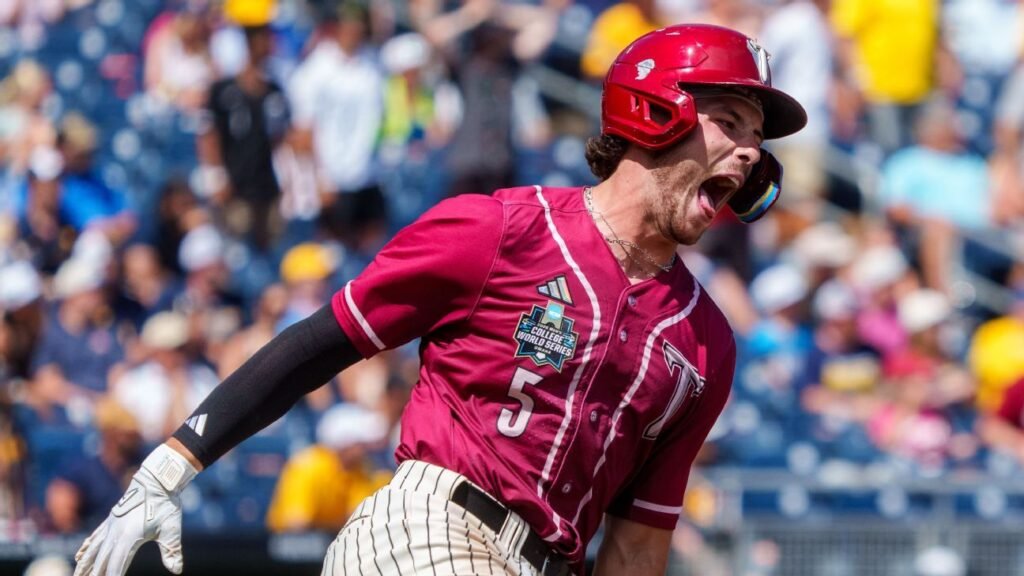
What a thrilling college baseball season we witnessed! Oklahoma claimed its third Men’s College World Series title in program history as the SEC continued its dominance of the tournament, having now won seven straight titles.
From a team such as Troy advancing to the MCWS as one of the last teams to even make the tournament to the Branch brothers leaving their mark in Omaha, Nebraska, to West Virginia’s epic fans and crowds, we saw a little bit of everything that makes college baseball so great.
Our college baseball experts review the 2026 tourney and give some early predictions for 2027.
Jump to:
Tourney highlights | Oklahoma’s legacy
Can UNC recover? | What to watch in 2027
Predictions
1. What was your favorite part about this year’s MCWS?
0:45
Branch Bros: Kolby goes yard vs. his brother Kyle in final collegiate at-bat
Ryan McGee: The energy. There’s always a boost when we have new blood party crashers, and this year there were two! The lead-in was one of the most exciting 64-team tourneys in recent memory, and that spirit absolutely transferred to Omaha. We’ve all written and said a lot about the momentum of college baseball in recent years, and you could really feel that this June, even while a lot of other massive sporting events were happening at the same time.
Chris Burke: There was nothing better this year than the two sets of brothers we had in Omaha. Kolby and Kyle Branch and LJ and Xander Mercurius left us with memories that will never be forgotten!
Mike Rooney: I will stretch for two here. The Branch family gave us all of the feels in Omaha as brothers Kolby and Kyle both homered in their final at-bats of the 2026 season. And watching their parents take in the moment when the boys low-fived each other as Kolby rounded the bases one final time … that is the good stuff. Finally, West Virginia’s team singing “Country Roads” with their fans at the Men’s College World Series was a perfect capper to an incredible NCAA tournament.
David Dellucci: The Men’s College World Series is called the “Greatest Show on Dirt,” uniting fans nationwide for two weeks in Omaha. Where else can you scream Boomer Sooner, chant Hotty Toddy and sing “Take me Home, Country Roads” with a group of strangers in a nice steakhouse? I loved seeing how much college baseball’s popularity is growing, with 360,000 total attendees and stars like Eric Church, Brian Bosworth and even Pat McAfee hosting his show in town and in the stands supporting their schools, shows how big this sport has become.
2. What does this win do for Oklahoma’s legacy?
McGee: Oklahoma officially becomes the kind of secret great college baseball program that is no longer a secret. Only 10 teams have won three or more MCWS championships, and now the Sooners are one of them. Someone should write a story about that. Oh wait … we did!
Burke: Oklahoma has sometimes been on the back burner in its own state, much less from a national standpoint, but that is no longer the case. The Sooners are the champs, they are getting a huge facelift to their facility, and they return three freshmen starters. I’d say that OU baseball is in a great place.
Rooney: Oklahoma’s baseball program joined the SEC without resources comparable to its new peers. This was particularly acute on the facility side. There was concern that the Sooners weren’t ready for the rigors of the league. And in fairness, OU has finished 12th and 11th in the SEC over the past two seasons. But this national title reminds us, for the third time, that the best version of this program can compete with anyone.
Dellucci: Oklahoma’s 2026 title run was nothing short of amazing. Despite late season struggles, losing their last four conference series and a single elimination game in the conference tournament, they beat five national seeds including the ACC, Big 10 and SEC regular-season and tournament champions — not one, but two games each. The offense improved from hitting 48 home runs in their first 47 games to 47 homers in the last 19 and entered Omaha ranked 80th in batting average and 78th in ERA. Yet it still made an incredible run with three freshmen pitchers started every MCWS game and finishing off North Carolina in the finale, who was 29-0 when Caden Glauber pitched. Through the Sooners have long been known for other sports, they’ve now firmly established their legacy in baseball.
3. How can UNC recover from another brutal loss?
McGee: The Heels might very well have overtaken Florida State when it comes to being the greatest program to never win at all. They are certainly the greatest of this century to not do it. But this also feels a lot like 20 years ago, when UNC first figured out how to become an Omaha regular. I don’t think this was a one-off finals run like we’ve seen from a lot of teams in recent years. This feels like a foundation being built for the long haul.
Burke: North Carolina will take some time to recover from a 13th trip to Omaha without a title. However, the Tar Heels have a world-class coaching staff and arguably the best freshman pitcher in the country in Caden Glauber, so UNC is going to be just fine.
Rooney: There’s no getting around the devastating nature of this loss for North Carolina. The Tar Heels’ third trip to the MCWS finals presented a white-hot opponent in Oklahoma, but certainly not one of the SEC’s traditional blue bloods. The ACC has a confidence problem in Omaha and UNC had a chance to push back on that narrative. The good news is that the Tar Heels have now made a remarkable nine trips to the MCWS in the past 20 years. They are regulars at the MCWS and this program is thriving.
Dellucci: The thing about falling short of winning a championship is that it makes you more determined and motivated to improve for the next season. North Carolina has made it to Omaha 13 times and been the runner up in 2006, 2007 and now 2026. The Tar Heels will build around key freshman pitchers such as Glauber and Jackson Rose and sophomores Walker McDuffie and Ryan Lynch, who all will help get them right back in the NCAA tournament.
4. What teams and players should we have our eyes on next year?
McGee: Spoiler alert: Oregon State has another big-time ace. I am going to make it a mission to see Dax Whitney pitch for the Beavs next year. I always love me some dual threats, so I’ll be watching TCU’s Noah Franco. And I can’t imagine how good Florida’s Brendan Lawson will be in his third year.
Burke: One of the best things about Omaha is it provided us with a sneak peek to some of the best players in the country heading into next season. While there are plenty of stars who weren’t in Omaha — Landon Harrison (Arizona State), Tague Davis (Louisville) and Brendon Lawson (Florida) come to mind — there were plenty of underclassmen who were that will be All-American-type players next year. Troy’s catcher Jimmy Janicki will be an MLB draft first-rounder next year. Texas has big-time returning star power in pitchers Sam Cozart and Dylan Volantis along with position players Anthony Pack Jr. and Adrian Rodriguez, and of course UNC’s star freshman pitcher Caden Glauber will be back and one of the best starters in the country next year. This is just a sampling of the returning stars; college baseball is in a great place!
Rooney: Freshman sensation Glauber took the mound 30 times for North Carolina, and the Tar Heels went 29-1 in those games. He is a special talent, and he is not alone in college baseball’s rising sophomore and junior classes. Cord Rager and Xander Mercurius are two elite arms returning for Oklahoma. Chase Fralick (Auburn), Gavin Kelly (West Virginia). Davis and Hairston are four elite hitters in the junior class. Texas returns underclassmen Volantis, Pack and Cozart. The abundance of talent in college baseball continues to amaze.
Dellucci: It would be hard to imagine Oklahoma not being in the mix for another chance at a national championship next season considering their starting rotation will be a year older and coming off of a dominant post season run. I’d also keep an eye on Auburn which finished the 2026 season with a 44-22 overall record and a final ranking at No. 9. The Tigers lost in the super regionals with a roster consisting of key players who were mostly freshman and sophomores.
5. What are your early thoughts for next year’s tournament and MCWS?
McGee: Yes, the SEC packed the Omaha bracket and yes, the conference won yet another natty, but there’s a leveling of the playing field that’s taking place. You could see it in the larger 64-team tourney. This sport had been the SEC beating up on the world, but now it’s feeling more like the SEC versus the world. I want to see if that trend continues to creep along, or if the SEC simply shores up its defenses once again.
Burke: The SEC has won seven straight titles and many of the league’s top programs missed the MCWS this year. It’s hard to picture a scenario where there aren’t four or five SEC teams battling it out for the title again next year.
Rooney: Troy, Kansas and West Virginia showed us that national relevance in baseball is refreshingly attainable. St. John’s and Little Rock won regionals as 4-seeds. That is an unlikely feat in theory, yet it has happened five times in our past four NCAA tournaments. The chaotic nature of this format has been incredibly compelling. That said, powerhouse programs such as LSU, Vanderbilt and Clemson, to name a few, have spent the past month plotting their revenge tours. How this all plays out is anyone’s guess, but I could not be more excited to watch.
Dellucci: Next year’s MCWS could bring more underdog stories. This year saw new teams break through for first-ever trips to Omaha, including smaller schools making some noise. I expect fresh faces again with energized fan bases, proving that momentum and grit can put new programs on college baseball’s biggest stage.
[ad_2]
Credit to: Source link