NBA execs react: Celtics trade Jaylen Brown to 76ers



Tim MacMahon
Multiple Authors
Not since the Dallas Mavericks dumped Luka Doncic, shipping him to the Los Angeles Lakers in the middle of the night in early February 2025, has the NBA collectively been so stunned by a trade.
In that instance, the shock hit on two fronts. It seemed unfathomable that Doncic, a perennial first-team All-NBA selection entering his prime who was only months removed from leading the Mavericks to the NBA Finals, would get traded when his intention was to sign an extension to stay in Dallas. And the return in the deal was immediately considered to be ridiculously low value.
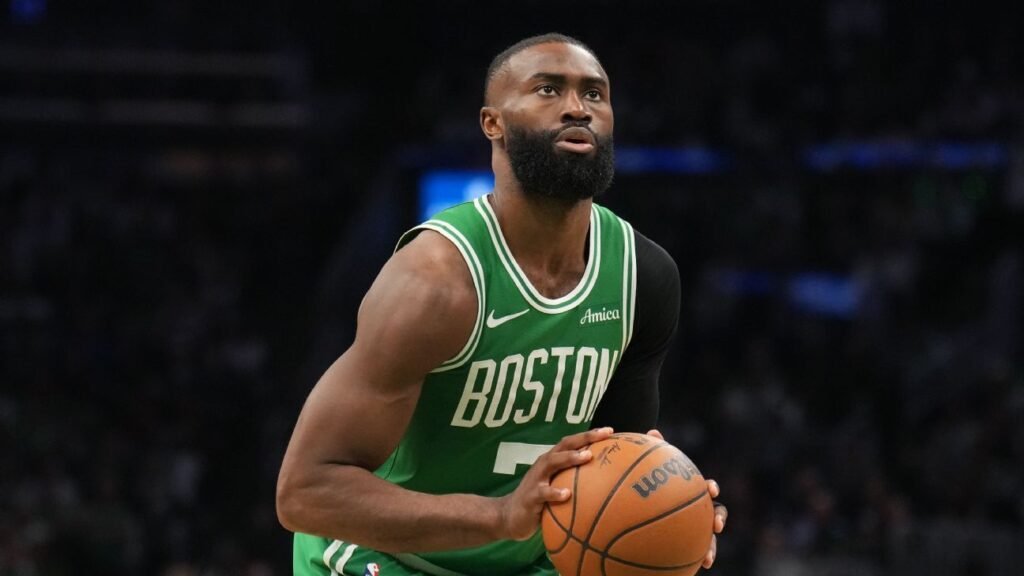
Nobody was flabbergasted that the Boston Celtics made the decision to trade Jaylen Brown, the Finals MVP in that series over Doncic’s Mavericks only two years ago, considering that he had been blatantly shopped for weeks. But to a bitter rival for that return? Eyebrows raised and jaws dropped across the league.
“I mean, the guy got traded for less than Walker Kessler,” one general manager told ESPN, referring to the promising young big man who has yet to earn an All-Star bid. “That’s baffling to me.”
Indeed, the Utah Jazz landed a pair of unprotected first-round picks and a pair of unprotected swaps from the Lakers in the sign-and-trade deal that delivered Doncic the center he so strongly desired. And the Jazz didn’t have to take back any salary, much less a bloated contract.
By contrast, the Celtics netted one unprotected first-rounder, another first-round pick or swap depending on where it lands, and a pair of second-rounders from the Philadelphia 76ers for Brown, a five-time All-Star in his prime. Plus, the Sixers unloaded oft-injured 36-year-old Paul George in the deal, shedding what’s widely considered one of the NBA’s worst contracts (two years, $110.7 million remaining).
Why was the trade market so chilly for a star who just had his best statistical season and finished sixth in MVP voting? Why was Boston president of basketball operations Brad Stevens — selected by his peers as Executive of the Year in two of the past three seasons — in such a hurry to pull the trigger on an underwhelming trade? Why didn’t the Celtics go all-in on their offer to the Milwaukee Bucks for Giannis Antetokounmpo if moving on from Brown was deemed a must?
“I’m asking all the same questions,” another general manager said.
Value, especially in today’s NBA, is in the eye of the beholder.
Without question, the 29-year-old Brown is one of the league’s most productive players. He ranked fourth in the league in scoring with a career-high 28.7 points per game last season. He also averaged career bests of 6.9 rebounds and 5.1 assists, joining Doncic and multitime MVPs Antetokounmpo and Nikola Jokic as the only players to average at least 25 points, six rebounds and five assists. And Brown, unlike Doncic and Jokic, is a good defender who frequently guards the opponent’s top scorer.
The Celtics far exceeded expectations with Brown as their No. 1 offensive option, going 56-26 despite Jayson Tatum missing most of the season while recovering from a ruptured Achilles tendon. Brown won a lot in Boston — more than any other player over the past decade, as he pointedly mentioned on social media over the weekend.
Those are all facts that have fueled the popular perception — from media, fans and other players — that Brown ranks among the league’s elite. The advanced analytics tell a different tale.
“The stats guys in every room don’t see him close to that — probably the widest gap in the league,” the second general manager said. “They’re certainly telling you they don’t think he’s the sixth-best player in the league. Then the contract is really f—ing big, and the expectation to [extend] that is really big.”
Notably, the Celtics have had a better net rating with Brown off the floor than on it in each of the past four seasons and six of the past eight. Teams use different analytical models, but the consensus is that Brown’s impact isn’t as impressive as his media-voted accolades or the supermax contract that will pay him $183 million over the next three seasons.
“The credit goes to guys who score, but they’re not always driving team success,” a third general manager said. “There’s guys like this all over the league — Brandon Ingram, DeMar DeRozan, etc. The difference is he’s not at $40 million [salary] — he’s at $60 million!
“It’s really hard to tie up that much of your salary cap in one player unless they’re truly generational. And he’s not even close to that. If you supermax Shai [Gilgeous-Alexander] or Joker, it makes sense. That’s probably the list. The league is getting smarter now. And here’s the thing: The dumb teams are also the cheap teams, so the Celtics couldn’t take advantage of one of them.”
1:55
Perk: Jaylen Brown right to feel disrespected by Celtics
Several scouts and executives said potential trade partners were also concerned about the reasons the Celtics might be so motivated to move Brown in the middle of his prime. The belief around the league is that the Celtics determined that Brown’s partnership with Tatum, which generated tension that Boston managed for years before the duo helped hang the franchise’s 18th championship banner, had run its course after nine seasons.
The common perception is that Brown’s unapologetically strong personality, outspokenness and reluctance to adapt his style of play factored into the Celtics’ front office’s decision that he needed to be traded now. That prompted worries about how Brown would fit with other teams with established stars.
“If Jaylen isn’t happy winning Finals MVP, All-NBA, winning with the Boston Celtics, how’s it going to be with us?” a president of basketball operations said. “If he’s not happy there, what is he looking for? It scares teams.”
The Celtics aimed for a superstar-type return for Brown, beginning by engaging the Bucks in discussions about a deal for Antetokounmpo. Boston finished as the runner-up to the Miami Heat in the Greek Freak derby after the Celtics refused to budge from their offer of Brown and two first-round picks but not including intriguing young prospects.
Stevens’ stubbornness under the circumstances befuddles some of his peers.
“I like Baylor Scheierman and Hugo Gonzalez, but those guys aren’t moving the needle,” the first general manager said. “I’d rather have Giannis and not those two than Paul George with those two.”
Added the second general manager: “If you knew you were going to trade him, why not go all in for Giannis? It was still a hard decision for Milwaukee. If you knew you had to get rid of him and you were in the final two, why not put in a bit more?”
The Celtics didn’t have contingency plans in place after missing out on Antetokounmpo. They canvassed the league at that point for potential trade partners and continued to be extremely aggressive in their proposals, such as asking for four unprotected first-round picks. That’s a decision that multiple executives said backfired on Boston.
“The asking price for Brown was so high that teams got scared away and moved on to other business,” said an executive from a team that engaged in brief discussions with the Celtics. “There was no need to circle back.”
Several potential suitors made major moves while the Celtics waited for a strong market to materialize for Brown.
Then on July 1 — almost three months before training camp starts — the Celtics traded Brown for the best, and possibly only, offer on the table.
“You can’t make sense of it other than they had to do something. They had to,” a pro personnel scout said. “They couldn’t bring him back. He wore out his welcome there. But it’s a bad move. It looks bad, too. They panicked and made a bad decision.”
Several executives said they thought that Stevens erred by accepting a pennies-on-the-dollar return so soon. They were puzzled by the sense of urgency, figuring that Philadelphia wouldn’t find another taker for George.
“I’m surprised they felt so forced to do it right now — to Philly and for that package!” the first general manager said. “I’m shocked. I don’t understand it. I can’t figure it out.”
However, other executives understood the decision, as difficult as it was for Celtics fans to swallow. One noted that the trade market tends to dry up after free agency. Another pointed out that trade value typically decreases the longer a player lingers on the market when the rest of the league knows a team feels pressure to move on from him.
“Some of the suitors fell away and they thought, ‘We’ve got to do something.’ And this was their best offer,” the president of basketball operations said. “Could they have waited? Could they have repaired [the relationship] with Jaylen?
“If you’re in three or four weeks of talks and went from five suitors to one, maybe you get nervous. If you don’t think [Brown’s return to Boston] is tenable, it’s better to make a bad trade than none at all.”
[ad_2]
Credit to: Source link